Why Your Supplements Work Differently When You Take Them With Coffee
Quick Answer: Coffee and tea contain polyphenols and caffeine that reduce absorption of some minerals — iron most severely, with smaller effects on zinc, calcium and magnesium. Fat-soluble vitamins are largely unaffected, and creatine is unaffected. The simple fix is a one-hour gap between coffee and any iron or multi-mineral supplement, which is usually easier than changing either habit.
You take your supplements at the same time every morning, which is exactly what you were told to do.
You also take them with the first coffee of the day.
One of those habits is quietly undoing the other.

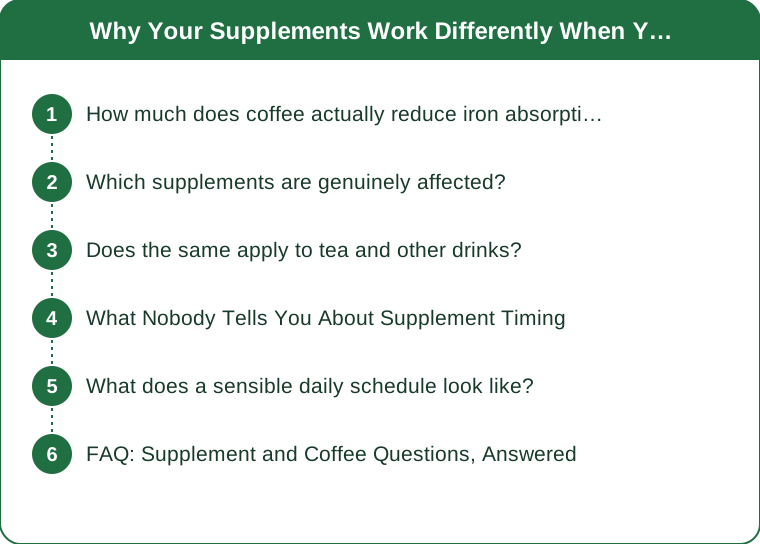
How much does coffee actually reduce iron absorption?
Substantially, and it is the clearest interaction of the lot.
The compounds responsible are polyphenols — chlorogenic acids in coffee, tannins in tea — which bind to non-heme iron in the gut and form complexes your body cannot absorb. Studies have found that a cup of coffee taken with an iron-containing meal can reduce absorption by roughly half, and strong tea can be worse still.
Timing matters enormously. Coffee taken with or shortly after the supplement produces the effect. Coffee taken an hour before appears to have very little impact, because the polyphenols have largely cleared.
If you have been prescribed iron, this is worth taking seriously rather than treating as a nuance. Pairing iron with vitamin C — a glass of orange juice, or a supplement containing ascorbic acid — pushes absorption in the other direction and can partly offset dietary inhibitors.
Which supplements are genuinely affected?
Fewer than the internet suggests, but the ones that are affected matter.
Meaningfully affected: iron, most of all. Zinc and calcium to a lesser degree, partly through polyphenol binding and partly because caffeine slightly increases urinary excretion of calcium and magnesium.
Mildly affected: magnesium, mostly through the excretion route rather than absorption. The effect is small at normal coffee intakes.
Not meaningfully affected: vitamin D, vitamin K, vitamin E and vitamin A, which are fat-soluble and depend on dietary fat rather than on polyphenols. Creatine is unaffected — in fact caffeine and creatine are routinely taken together in pre-workout products without an absorption problem. B vitamins are broadly fine, though caffeine is a mild diuretic and very high intakes may modestly increase losses.
Protein powder is unaffected, and adding coffee to a shake is purely a taste decision.
Does the same apply to tea and other drinks?
Tea is generally worse than coffee for iron, which surprises people.
Black tea is high in tannins, and a strong cup with a meal can reduce non-heme iron absorption by a large margin. Green tea has a similar effect. Herbal infusions vary — peppermint and chamomile are low in the relevant compounds, while some fruit and hibiscus blends are not.
Other common inhibitors worth knowing about: calcium competes directly with iron for absorption, so an iron supplement with milk or with a calcium tablet is a poor combination. Phytates in whole grains and legumes reduce mineral absorption, which is a normal part of a good diet and not something to avoid, but it is a reason to keep iron away from a high-bran breakfast.
On the other side, vitamin C and the so-called meat factor in animal protein both improve non-heme iron absorption.

What Nobody Tells You About Supplement Timing
Consistency usually beats optimisation. A supplement taken imperfectly every day outperforms one taken perfectly three times a week. If moving your iron to mid-afternoon means you forget it, take it with breakfast and add vitamin C instead.
The gap only needs to go one way for some things. For iron, coffee before is fine and coffee after is not. That is a much easier rule to live with than avoiding coffee for hours.
Splitting a dose often beats a bigger dose. Absorption of several minerals is saturable, meaning a single large dose is absorbed less efficiently than the same total split across the day. For iron specifically, some research suggests alternate-day dosing can actually absorb better than daily dosing.
Fat-soluble vitamins need actual fat. Taking vitamin D with a black coffee and nothing else is a poor plan — not because of the coffee, but because there is no fat in the meal to carry it. Take it with the meal of the day that contains the most fat.
Most multivitamins are already a compromise. They combine iron and calcium in one tablet, which are direct competitors. If you have a specific deficiency being treated, a targeted single supplement almost always outperforms a multi.
What does a sensible daily schedule look like?
Something like this, adjusted to your own routine.
On waking: coffee, if that is your habit. No supplements yet.
With breakfast, roughly an hour later: fat-soluble vitamins — D, K, E — with a meal containing some fat. This is also a reasonable slot for a multivitamin if you take one.
Mid-afternoon, away from coffee and tea: iron, if prescribed, with a source of vitamin C and away from dairy. Many people tolerate iron better with a small amount of food, even though absorption is technically higher on an empty stomach.
Evening: magnesium, which some people find supports sleep quality and which is well away from the day’s caffeine. Creatine can go anywhere, including with coffee.
The underlying principle is simple: cluster the fat-soluble things with a fatty meal, and keep the minerals away from your caffeine. Two rules cover almost everything.
This is general information, not medical advice. If you are treating a diagnosed deficiency or taking prescribed medication, timing can interact with your treatment — check with a pharmacist or doctor.
FAQ: Supplement and Coffee Questions, Answered
How long should I actually wait after coffee?
One hour is the commonly cited gap and is sufficient for most people. Taking the supplement first and having coffee an hour later works equally well and is often easier.
Does decaf still interfere?
Partly. The polyphenols responsible for most of the iron effect are still present in decaf, so it is not a workaround. The caffeine-related excretion effects do go away.
Is it worth taking supplements at all if the timing is imperfect?
Almost always yes. Reduced absorption is not zero absorption, and the difference between taking something imperfectly and not taking it is far larger than the difference between perfect and imperfect timing.
TL;DR:
- Coffee and tea polyphenols can cut iron absorption by roughly half when taken together; the effect on other nutrients is much smaller.
- Fat-soluble vitamins and creatine are unaffected — take those with a fatty meal or whenever is convenient.
- A one-hour gap solves the problem, and coffee before the supplement is far less of an issue than coffee after.
- Pair iron with vitamin C, keep it away from calcium, and prioritise consistency over perfect timing.
Most supplement advice tells you what to take. Rather less of it tells you what is sitting in the same mug.
Keep Reading
This article is for general informational purposes only and is not medical advice. Always consult a qualified health professional for guidance specific to you.