Why You Cannot Judge a Supplement Before the First Tub Is Finished
Quick Answer: Most supplements have a build-up period before any effect is possible — typically 2-4 weeks for magnesium and creatine, 8-12 weeks for vitamin D and omega-3. Judging at two weeks tells you almost nothing except whether you tolerate it. The exception is anything acute, like caffeine or electrolytes, which works within hours. Match your evaluation window to the mechanism, and decide the window before you start.
You bought it, you took it for twelve days, you felt no different, and it is now at the back of a cupboard.
That is the standard supplement lifecycle, and it is why most people’s cupboards contain four half-used tubs.
The problem is not the products, or not only the products. It is that almost nobody decides in advance how long they are going to give it, or what they are looking for.

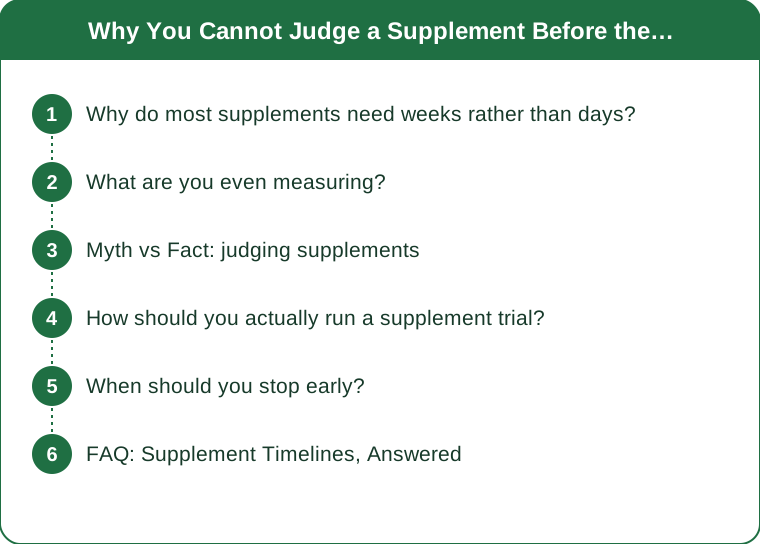
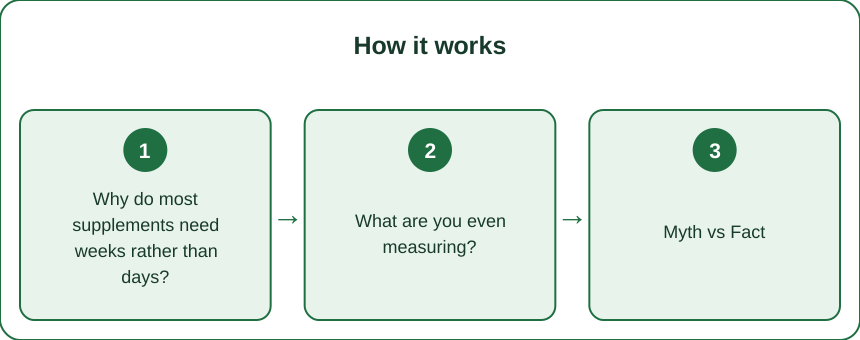
Why do most supplements need weeks rather than days?
Because they work by changing a stored level, not by producing an immediate effect.
There are broadly two kinds of supplement mechanism.
Acute mechanisms produce an effect from a single dose. Caffeine, electrolytes during exercise, some digestive enzymes. You take it, it acts, it clears. These you can evaluate the same day.
Cumulative mechanisms work by raising the amount of something in your body until it reaches a level where function changes. This takes as long as it takes to fill the store, and that depends on the dose, how depleted you were, and how the body handles that particular nutrient.
Realistic timelines for common ones:
- Creatine: muscle saturation takes around 3-4 weeks at standard dosing, faster with a loading protocol.
- Magnesium: subjective effects on sleep and cramping typically reported over 2-4 weeks.
- Vitamin D: blood levels rise slowly; 8-12 weeks before a meaningful change, and it should be guided by testing.
- Omega-3: incorporation into cell membranes takes 8-12 weeks.
- Iron: stores rebuild over months, though symptoms may improve sooner. Should always be guided by testing.
Two weeks is inside the build-up phase for every single one of these. You have not tested whether it works. You have tested whether you remembered to take it.
What are you even measuring?
This is the second failure, and it is bigger than the timeline one.
Most people evaluate a supplement by asking do I feel different? That question is almost useless, for three reasons.
It has no baseline. You do not remember accurately how you felt three weeks ago. Memory for subjective states is poor and heavily influenced by how you feel right now.
It has no control. Sleep, stress, training load, work and the season all changed over the same period. Attributing anything to the supplement is guesswork.
It is the wrong outcome for most products. Vitamin D does not produce a feeling. Omega-3 does not produce a feeling. Expecting a sensation from something that works on a blood marker guarantees the conclusion that it did nothing.
What to measure instead, chosen before you start:
- For creatine: a specific lift, same exercise, same rep range, tracked weekly.
- For magnesium and sleep: time to fall asleep or number of night wakings, logged with one line a day.
- For vitamin D or iron: a blood test before and after. There is no substitute and no reason to guess.
- For electrolytes: cramping frequency, or how you feel in the last 20 minutes of a long session.
One line a day in a notes app is enough. The measurement does not need to be rigorous. It needs to exist.
Myth vs Fact: judging supplements
Myth: If it works, you will notice. Fact: You will notice acute effects. Cumulative ones often produce changes small enough that only tracking reveals them — which does not make them worthless.
Myth: Feeling something in the first few days means it is working. Fact: Early sensations are usually side effects, placebo, or the taste and routine of taking something. Genuine effects from cumulative supplements arrive later than the sensations do.
Myth: A bigger dose speeds up the timeline. Fact: Sometimes marginally, often not at all, and for several nutrients absorption is rate-limited so extra is simply excreted. Splitting a dose usually beats doubling it.
Myth: If a tub is finished and nothing happened, it does not work for you. Fact: Possibly. Or the dose was too low, the form was poorly absorbed, you were not deficient in the first place, or you were not measuring the right thing. Finish the tub and know what you measured before concluding.
Myth: Stacking several new supplements at once saves time. Fact: It guarantees you learn nothing. If three things start together and something improves, you have no idea which one did it — and you are now committed to buying all three indefinitely.

How should you actually run a supplement trial?
Like a small experiment, with the rules set in advance. It takes five minutes to set up.
Before you start:
- Write down what you expect to change, specifically. Not more energy — fewer than two night wakings, or bench press 5kg heavier for the same reps.
- Set the review date based on the mechanism. Creatine: 4 weeks. Magnesium: 4 weeks. Vitamin D or omega-3: 12 weeks, with a test if relevant.
- Change one thing only. One new supplement at a time, with training and sleep habits held as steady as you can manage.
- Take a baseline. One week of the same measurement before starting.
During:
- One line a day. Date, dose taken yes/no, and the measurement.
- Do not evaluate mid-trial. Checking in at day 10 and deciding it is not working is the failure mode this whole system exists to prevent.
At the review date:
- Compare the log to the baseline, not to your memory.
- Decide: continue, stop, or extend once. Write the decision down.
The value of this is not scientific rigour. It is that you stop spending money on a rotating cast of half-used tubs, and you end up with two or three things you actually have evidence for.
When should you stop early?
There are legitimate reasons, and they are not about efficacy.
Stop immediately for:
- Any adverse reaction — rash, digestive distress that does not settle, headaches, anything unexpected.
- A new medication that might interact. Check before restarting.
- Anything your doctor advises against.
Stop or reassess within the first week for:
- Tolerability problems. Iron that makes you nauseous, magnesium oxide that causes digestive upset, creatine that bloats. These are often solved by changing form or timing rather than abandoning the supplement — magnesium glycinate instead of oxide, iron away from breakfast, creatine split across the day.
- A routine that clearly will not stick. If a supplement requires four doses a day and you have managed one, the trial is already invalid. Find a once-daily version or accept it will not work for you.
And one genuinely good reason to stop that people rarely consider: you started it for a problem that has resolved for another reason. Supplements accumulate in routines and stay there long after the reason has gone.
This is general information, not medical advice. Anything involving deficiency, medication interaction, pregnancy or an existing condition should be discussed with a doctor or pharmacist rather than trialled independently.
FAQ: Supplement Timelines, Answered
Is a loading phase worth it for creatine?
It gets you to saturation in about a week instead of three to four, which matters if you have a specific date in mind. Otherwise standard dosing reaches the same place with less digestive upset.
How do I know if the form matters?
For several nutrients it matters a great deal — magnesium and iron especially, where different salts have quite different absorption and tolerability. If a supplement is not working and you are past the timeline, form is the first thing to change, not dose.
What if I miss doses?
Occasional misses are fine for cumulative supplements — the store does not empty overnight. Frequent misses invalidate the trial. If you are missing more than one day a week, fix the routine before you evaluate anything.
TL;DR:
- Most supplements work cumulatively: creatine and magnesium need 2-4 weeks, vitamin D and omega-3 need 8-12.
- Do I feel different? is the wrong question — pick a specific measurement before you start and take a baseline week.
- Change one thing at a time, log one line a day, and do not evaluate mid-trial.
- Stop early only for adverse reactions, interactions, or a routine that clearly will not stick — and try changing form before abandoning.
The point of all this is not to be scientific about vitamins. It is that the alternative — buying something, taking it inconsistently for twelve days, and deciding on a feeling — is how people end up spending money every year and knowing nothing more than they did the year before.
Keep Reading
This article is for general informational purposes only and is not medical advice. Always consult a qualified health professional for guidance specific to you.