Why Your Supplement Routine Quietly Falls Apart When Your Schedule Changes
Quick Answer: Supplement adherence is a habit problem far more than a knowledge problem, and habits are anchored to routines rather than to intentions. When the school year restarts, work patterns change or mornings shift, the anchor disappears and the routine ends without a decision being made. The fix is to re-anchor to an event that survives the schedule change - usually a meal rather than a time - and to reduce the number of separate moments in the day when you need to remember something.
You were completely consistent in July. The bottles were by the kettle and it happened without thought.
It is now the second week of the new term and you genuinely cannot remember the last time you took anything.

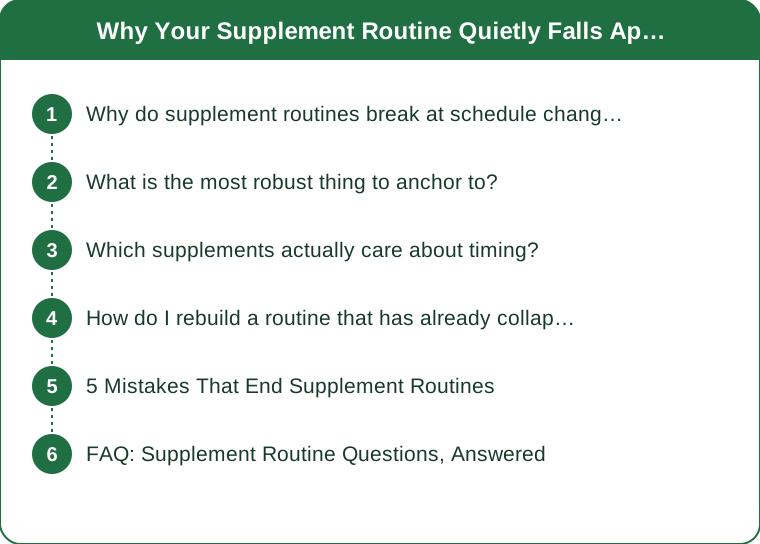
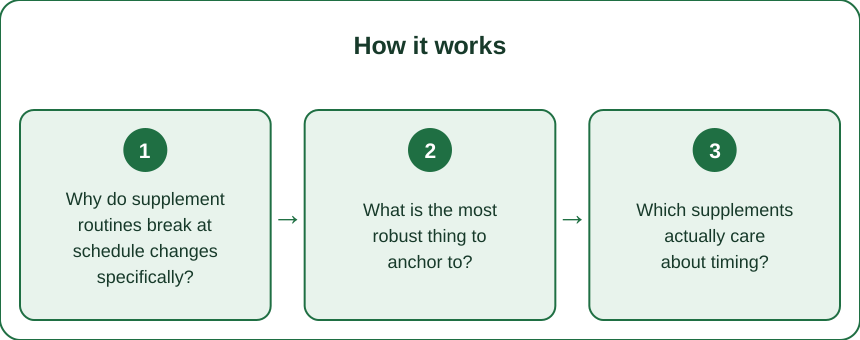
Why do supplement routines break at schedule changes specifically?
Because the routine was never really about the supplements - it was attached to a stable sequence of morning actions, and when the sequence changes the attached behaviour goes with it.
Habit research consistently points to context as the driver, meaning the cue, the location and the surrounding actions matter more than motivation.
A changed wake time is a complete context change, even if it is only forty minutes.
The bottles staying visible is not enough if the moment they were tied to no longer happens in that room.
And nothing signals the failure. You do not notice missing a day, so there is no correction until weeks have passed.
Which is why September and January are the two points routines reliably die.
What is the most robust thing to anchor to?
A meal, generally, rather than a clock time. Meals survive schedule changes better than times do, and many supplements are better absorbed with food anyway.
Choose the meal you never skip, which for most people is dinner rather than breakfast, despite breakfast being where everyone puts their supplements.
Anchor to the action, not the room - after I put my plate down, not when I am in the kitchen at seven.
Reduce the number of daily moments to one or two, since a routine with three separate timings has three chances to fail each day.
Use a weekly pill organiser, which converts a daily memory task into a weekly one and makes gaps visible immediately.
And put it where the anchor event happens, which may be the dining table rather than the kitchen counter.
Which supplements actually care about timing?
Fat-soluble vitamins are generally better absorbed with a meal containing fat, which is a real and simple consideration rather than a marketing point.
Iron absorption is affected by what it is taken with, and it is commonly advised to separate it from tea, coffee and calcium-rich foods. Ask a qualified professional about your situation.
Some people find magnesium more comfortable in the evening, though evidence for a specific timing benefit is limited and individual response varies.
Caffeine-containing products obviously have timing consequences for sleep, and late-afternoon doses are a common and overlooked cause of poor sleep.
Protein powder timing is far less critical than total daily intake, which is well supported and repeatedly overcomplicated.
And for most general vitamins, consistency matters more than timing - a supplement taken daily at an imperfect time beats a perfectly timed one taken twice a week. This is general information, not medical advice.

How do I rebuild a routine that has already collapsed?
Start with fewer items, not the full set. Rebuilding a five-item routine at once fails; restarting with the one or two that matter most usually holds.
Pick the new anchor deliberately based on your current schedule rather than the one you had in July.
Set a two-week reminder rather than a daily one, since daily notifications get dismissed automatically and stop working within days.
Audit what is actually in the cupboard first. Most collapsed routines include at least one expired bottle and one item bought for a reason that no longer applies.
Do not restart everything you were taking - a schedule collapse is a useful opportunity to drop the ones you cannot articulate a reason for.
And accept a lower bar. Five days a week is a functioning routine; treating anything under perfect as failure is what turns one missed day into three weeks. This is general information, not medical advice.
5 Mistakes That End Supplement Routines
1. Anchoring to a time instead of an event. Times change with the seasons, work patterns and school terms. Events like dinner survive all of them, which is why event-anchored routines outlast time-anchored ones.
2. Splitting across too many moments in the day. A morning item, a midday item and an evening item is three separate memory tasks. Consolidating to one or two, where appropriate, roughly doubles adherence for most people.
3. Buying more than you take. A cupboard with eleven bottles is a cupboard where nothing gets taken consistently, because the routine becomes a decision rather than an action. Fewer items, taken reliably, is the better position.
4. Keeping them out of sight after a house tidy. An enormous number of routines end when the bottles move into a cupboard during a kitchen clear-out. Visibility is doing more work than anyone credits.
5. Treating a missed week as a reason to stop. Adherence is not binary, and the people who maintain routines for years are not the ones who never miss - they are the ones who restart without ceremony.
And the bonus: not knowing why you take something. If you cannot say what an item is for, that is the one that will quietly disappear, and probably should. Discuss what is appropriate for you with a qualified healthcare professional. This is general information, not medical advice.
FAQ: Supplement Routine Questions, Answered
What is the best time of day to take supplements?
The time you will actually take them consistently, with the caveat that fat-soluble vitamins are generally better absorbed with a meal containing fat. Consistency outweighs optimisation for most people.
Should I take everything at once?
Consolidating reduces the number of chances to forget, but some items are better separated - iron and calcium being a common example. Ask a qualified professional about your specific combination.
Does a pill organiser really help?
Substantially, for most people. It converts a daily memory task into a weekly one and makes a missed day immediately visible rather than invisible.
How long before I notice anything?
It depends entirely on the item and on whether you had an insufficiency to begin with. Many supplements produce no perceptible day-to-day effect, which is itself a reason routines lapse.
Is it bad to miss days?
For most general supplements, occasional missed days are not significant. For anything prescribed or recommended by a healthcare professional, follow their guidance rather than general advice.
Should I restart everything after a lapse?
Restart with the items you can explain a reason for, and treat the lapse as a chance to reduce the list. Rebuilding a large routine at once is the most common way a restart fails.
When should I talk to a professional?
Before starting anything new if you take medication, are pregnant, or have a health condition, and any time you are unsure whether an item is appropriate for you. This is general information, not medical advice.
TL;DR:
- Supplement routines die at schedule changes because they were anchored to a routine, not a decision.
- Anchor to a meal you never skip rather than a clock time - events survive schedule changes.
- Consolidate to one or two moments a day; three timings means three daily chances to fail.
- A weekly organiser turns a daily memory task into a weekly one and makes gaps visible.
- Rebuild with fewer items than you had, and drop anything you cannot explain.
The routine did not fail on willpower - the anchor moved. This is general information, not medical advice.
Keep Reading
This article is for general informational purposes only and is not medical advice. Always consult a qualified health professional for guidance specific to you.