Why Your Magnesium Supplement Isn't Actually Helping Your Sleep
Quick Answer: Not all magnesium supplement forms are equally suited for sleep — magnesium oxide (a common, cheap form) has poor absorption and is mainly used as a laxative, while magnesium glycinate or threonate are better absorbed and more specifically associated with relaxation and sleep support. Checking which form you’re actually taking often explains a lack of noticeable effect.
You did the research, bought a magnesium supplement, and took it consistently before bed for weeks. If sleep hasn’t noticeably improved, the type of magnesium in that bottle is very likely the reason, not that magnesium itself doesn’t work for you.

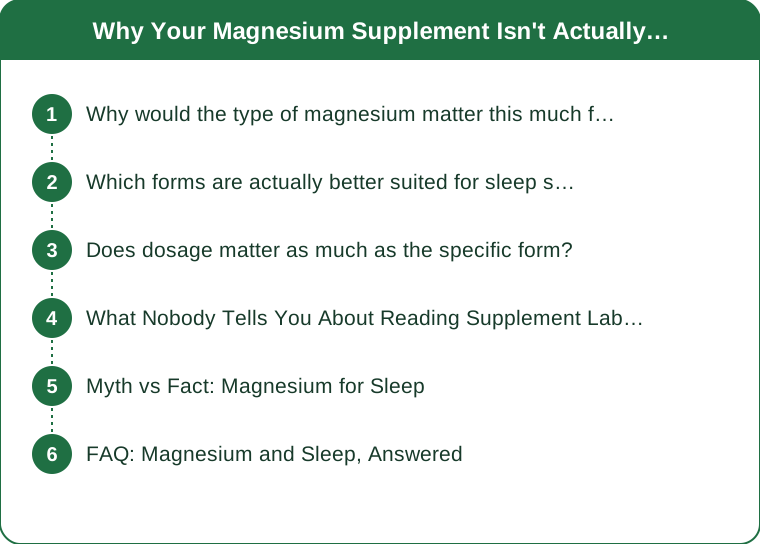
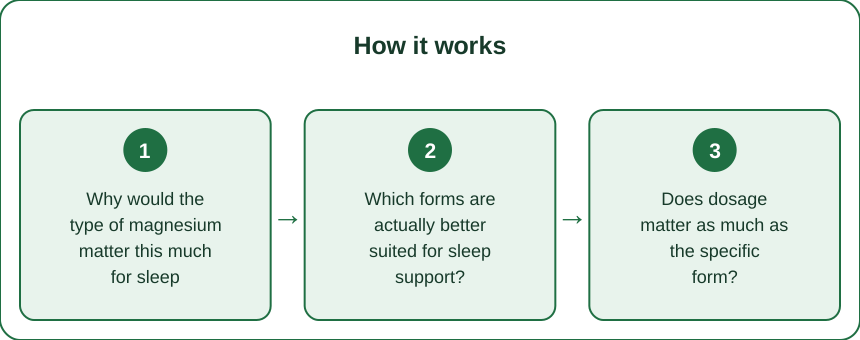
Why would the type of magnesium matter this much for sleep specifically?
Different magnesium compounds have meaningfully different absorption rates and physiological effects. Magnesium oxide, one of the most common and cheapest forms sold, has notably poor bioavailability (the body absorbs relatively little of it) and is primarily used for its laxative effect rather than any targeted relaxation or sleep benefit — taking it specifically hoping for sleep support often yields minimal noticeable effect precisely because so little is actually absorbed.
Which forms are actually better suited for sleep support?
Magnesium glycinate and magnesium threonate are generally better absorbed and more commonly associated with calming, sleep-supportive effects in the research and anecdotal use around magnesium supplementation. Glycinate specifically pairs magnesium with glycine, an amino acid itself associated with relaxation, which may contribute an additional calming effect beyond the magnesium alone.
Does dosage matter as much as the specific form?
Both matter together — even a well-absorbed form taken at too low a dose may not produce a noticeable effect, while the right dose of a poorly absorbed form still won’t help much. Checking both the elemental magnesium amount (not just total compound weight) and the specific form gives a more complete picture than checking either factor alone.

What Nobody Tells You About Reading Supplement Labels for This
Here’s a detail many labels obscure: some products list ‘magnesium (as magnesium oxide and magnesium glycinate blend)’ without clarifying the ratio, meaning a bottle could be mostly the poorly-absorbed oxide form with only a small fraction of the more effective glycinate — checking the supplement facts panel closely, or looking for products that specify a single clear form, avoids this ambiguity.
Myth vs Fact: Magnesium for Sleep
Myth: Any magnesium supplement will help with sleep equally. Fact: Absorption and physiological effect vary significantly by specific compound form — oxide is poorly suited for sleep support specifically.
Myth: A higher total magnesium number on the label always means a stronger effect. Fact: The specific form and elemental magnesium content matter more than the total compound weight listed.
Myth: If magnesium didn’t help your sleep, magnesium supplementation isn’t for you. Fact: Switching to glycinate or threonate specifically, rather than oxide, resolves this for many people.
FAQ: Magnesium and Sleep, Answered
How long should I try a better-absorbed form before judging effectiveness?
Most people who respond notice a difference within 1-2 weeks of consistent use, though individual response varies.
Is magnesium citrate a reasonable middle option?
Yes, it has better absorption than oxide, though it can have a mild laxative effect at higher doses for some people, worth watching for.
Should I take magnesium at a specific time before bed for best sleep effect?
Many people take it 30-60 minutes before bed, though consistency of timing matters more than the exact minute.
TL;DR:
- Magnesium oxide, a common cheap form, is poorly absorbed and mainly used as a laxative, not a sleep aid
- Magnesium glycinate and threonate are better absorbed and more specifically associated with sleep support
- Check both the specific form and elemental magnesium dose, not just the total number on the label
- Blended-form products can obscure how much of the effective form you’re actually getting
Check your current bottle’s specific magnesium form tonight — if it’s primarily oxide, switching to glycinate is the more likely fix for the sleep support you were originally hoping for.
Keep Reading
This article is for general informational purposes only and is not medical advice. Always consult a qualified health professional for guidance specific to you.