Why Storing Supplements in the Bathroom Quietly Wastes Them
Quick Answer: Bathroom cabinets cycle through high heat and near-saturated humidity several times a day. Moisture is the main enemy for most supplements — it degrades probiotics, effervescent tablets, gummies, fish oil and vitamin C measurably faster than time alone does. A cool, dry, dark cupboard away from the hob is a better default, and it costs nothing to switch.
The cabinet is right there, it is where the toothbrush is, and it is where almost everyone keeps their supplements.
It is also the most humid, most temperature-unstable place in the house.

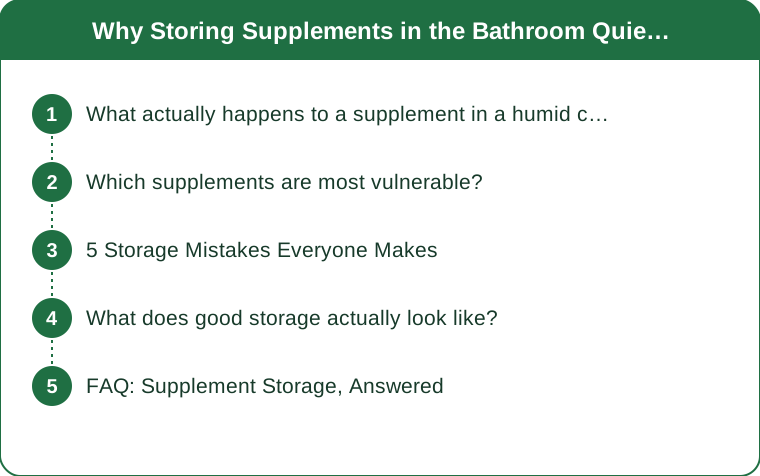
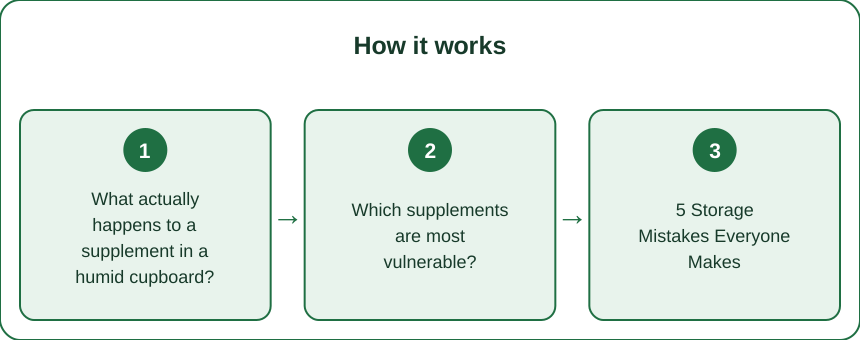
What actually happens to a supplement in a humid cupboard?
Water gets in, and once it is in, chemistry starts.
A hot shower pushes bathroom humidity toward saturation within a few minutes, and it stays elevated long afterwards. Every time the cabinet is opened during or after that, moist air enters. When the room cools, that moisture condenses onto surfaces — including the inside of a bottle that has been opened.
Most supplement degradation pathways need water. Hydrolysis breaks apart the molecules in question; oxidation accelerates in the presence of moisture and warmth. This is why the desiccant sachet is in the bottle in the first place, and why it stops working once it has absorbed all it can — which happens far faster in a humid environment.
Signs it is already happening:
- Tablets that have become soft, discoloured or speckled
- Powder that has clumped into a solid block
- Gummies fused together or gone sticky
- Capsules that have deformed or stuck together
- Fish oil capsules that smell strongly fishy when the bottle is opened
That last one is worth dwelling on. A strong fishy smell is rancidity, which means the oils have oxidised. Rancid fish oil is not delivering the benefit you bought it for, and oxidised lipids are not something you particularly want to be consuming daily.
Which supplements are most vulnerable?
The ranking is fairly consistent, and it is not the one most people expect.
Probiotics — by far the most fragile. These contain live organisms, and viability falls with heat and moisture. Many require refrigeration, and those that are shelf-stable are shelf-stable under specified conditions, not under any conditions. A probiotic kept in a warm bathroom for six months may be delivering a small fraction of the count on the label.
Fish oil and other oils — oxidise readily. Heat and light both accelerate it. Vitamin E, evening primrose, flaxseed and algal oils all behave similarly.
Effervescent tablets and powders — extremely hygroscopic. They are designed to react with water. Ambient humidity starts that reaction slowly in the tube, which is why they lose fizz and why the tube has such an aggressive stopper.
Gummies — the worst format for storage generally. High surface area, sugar that attracts moisture, and gelatin or pectin that softens with heat. They also tend to be underdosed relative to the label to begin with.
Vitamin C and B vitamins — moderately sensitive to heat, light and moisture.
Minerals in tablet form — the most robust. Magnesium, zinc, iron and calcium tablets tolerate poor storage comparatively well, which is why they are the ones that look fine in a bathroom cabinet three years on.

5 Storage Mistakes Everyone Makes
1. The bathroom cabinet. Covered above, and it is the big one. Move them to a bedroom drawer or a kitchen cupboard away from heat and it is solved.
2. The cupboard above the kettle or the hob. The second worst location, and one people move to when they leave the bathroom. Steam plus radiant heat is the same problem in a different room. A cupboard on the other side of the kitchen is fine; the one directly above a heat source is not.
3. Throwing away the desiccant sachet. It is doing a job. It should stay in the bottle until the bottle is finished, and the cotton wool on top of a new bottle should be thrown away once opened, because it holds moisture against the tablets.
4. Decanting into a pretty jar or a weekly pill organiser for the month. Both increase exposure to air and moisture enormously. A weekly organiser is a reasonable trade for adherence, which matters more than marginal potency — but a monthly one, in a bathroom, in a clear container, is losing you real potency for aesthetics.
5. Leaving them in the car. Most common with a bottle kept in the door or the glovebox for convenience, and cabin temperatures make it the harshest environment your supplements will ever see. Even a few hot days will do measurable damage, particularly to anything oil-based or live.
And a sixth worth adding: buying the enormous value-size bottle. A 12-month supply spends most of its life opened, and every open-and-close exchanges air. Two six-month bottles are usually the better value once degradation is accounted for.
What does good storage actually look like?
Unglamorous and easy.
Cool, dry, dark, and stable. A bedroom drawer, a hallway cupboard, or a kitchen cupboard away from the hob, kettle and dishwasher. Room temperature away from swings is the goal — stability matters as much as the absolute number.
Keep them in the original container. Amber and opaque bottles are chosen deliberately to exclude light, and the closure is designed to seal. The original packaging also keeps the batch number and expiry with the product, which matters if anything is ever recalled.
Close it properly and promptly. Most moisture ingress happens during the seconds a bottle is open in a humid room, not through the sealed container.
Refrigerate what says to refrigerate, and check — some probiotics and liquid vitamin D preparations require it and lose potency quickly at room temperature. Fish oil keeps noticeably better in the fridge even when not required to be.
Treat expiry dates as an upper bound, not a guarantee. The date assumes proper storage from manufacture. A well-stored bottle is often fine slightly past it; a badly stored one may have lost meaningful potency well before it.
And apply the smell and appearance test. Rancid oil, clumped powder, softened tablets and fused gummies are all reasons to replace regardless of the date.
This is general information, not medical advice. If you take prescribed medication alongside supplements, storage requirements and interactions are worth checking with a pharmacist — they will answer this kind of question without an appointment.
FAQ: Supplement Storage, Answered
Does the fridge help everything?
No. Refrigeration is right for probiotics, some liquid preparations and fish oil, but it introduces a condensation risk for tablets and powders every time the container is opened and warm air meets a cold surface. Follow the label, and when it is silent, cool and dry beats cold.
Is a clumped powder still usable?
Usually yes in terms of safety, and it tells you moisture got in, which means some degradation has occurred. Whey and creatine tolerate this reasonably well; anything with vitamins or live cultures in the blend has lost more. If it has gone hard rather than lumpy, or smells off, replace it.
How much potency actually gets lost?
It varies enormously by compound and conditions, from negligible for a magnesium tablet to the majority of the viable count for a probiotic kept warm for months. That variability is the reason the practical advice is a location change rather than a calculation — moving the bottle costs nothing and removes the question.
TL;DR:
- Bathroom cabinets cycle heat and near-saturated humidity daily, and moisture drives most supplement degradation.
- Probiotics, oils, effervescents and gummies are the most vulnerable; mineral tablets are the most robust.
- Keep the desiccant, bin the cotton wool, keep products in original containers, and close them promptly.
- Avoid cupboards above kettles and hobs, and never store supplements in a car.
- Expiry dates assume good storage — smell and appearance are the more useful test.
None of this makes a supplement work better than it was ever going to. It just means you get what you paid for, which is a low bar that a surprising number of well-chosen supplement routines quietly fail to clear because of where the bottle happens to live.
Keep Reading
This article is for general informational purposes only and is not medical advice. Always consult a qualified health professional for guidance specific to you.