Why Iron Supplements Fail When You Take Them With Breakfast
Quick Answer: Iron absorbs best on an empty stomach with vitamin C, and worst alongside coffee, tea, dairy, or a high-calcium breakfast. Taking the same pill 60 minutes before your first cup instead of with it can raise absorption several-fold — no dose change needed.
You have been taking iron for three months. Your energy has not budged, your last panel barely moved, and your doctor asked whether you are actually taking it. You are. Every morning, with breakfast, like a responsible adult.
That is exactly the problem.

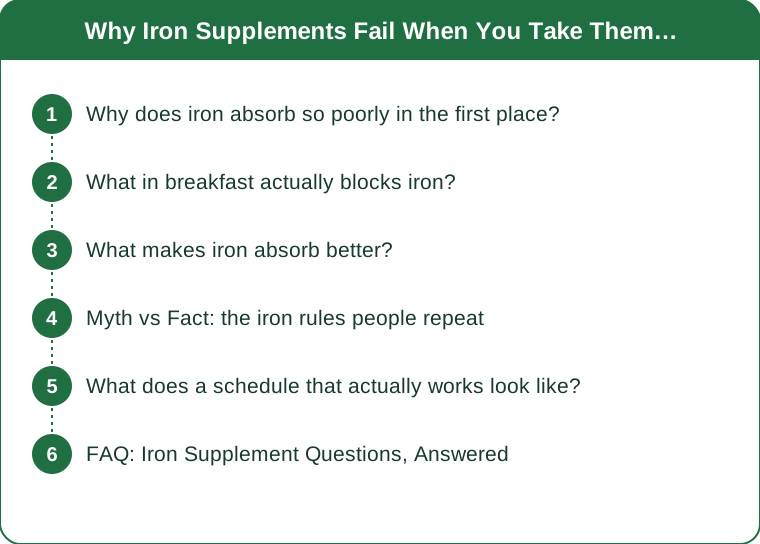
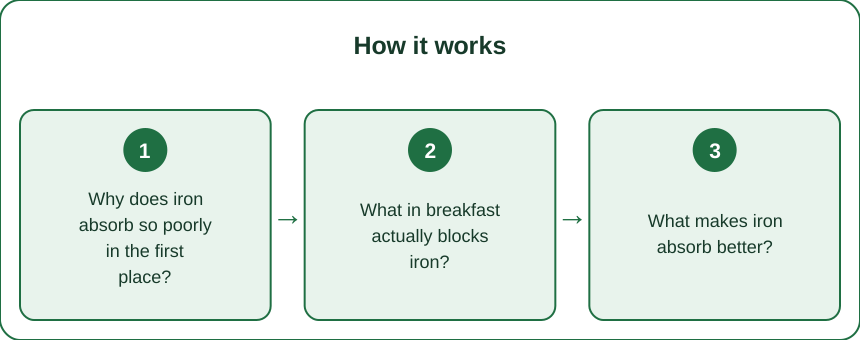
Why does iron absorb so poorly in the first place?
Iron is one of the least efficiently absorbed minerals in the human diet. Even under ideal conditions, your gut takes up roughly 10 to 15 percent of the non-heme iron in a supplement — the rest passes straight through.
That low ceiling is not a defect. Your body has no active way to excrete excess iron, so it defends itself by controlling the door at absorption. A hormone called hepcidin rises when stores are adequate and clamps the door tighter.
The practical consequence: when something in your breakfast blocks even a slice of that already-narrow window, the loss is not trivial. You are not shaving 10 percent off a big number. You are shaving a big number off a small one.
What in breakfast actually blocks iron?
Four things do most of the damage, and almost every standard breakfast contains at least two.
- Coffee and tea. Polyphenols and tannins bind iron in the gut. Studies have measured drops of 50 to 60 percent when coffee is consumed with an iron dose, and black tea can be worse.
- Calcium. Milk, yogurt, fortified cereal, a latte — calcium competes with iron directly. Around 300 mg (one cup of milk) is enough to cut absorption meaningfully.
- Whole grains and bran. Phytates in oats, whole wheat toast, and bran cereal chelate iron before you absorb it.
- Eggs. Phosvitin in egg yolk binds iron; a two-egg breakfast can reduce uptake by roughly a third.
Oatmeal with milk and coffee is, chemically speaking, close to an iron-blocking protocol.
What makes iron absorb better?
The single most useful lever is vitamin C. Ascorbic acid converts iron into a form your gut takes up more readily and shields it from binders. Around 100 mg — roughly half a large orange, or 4 oz of orange juice — is enough to measurably improve uptake.
An empty or near-empty stomach helps too, because stomach acid does the same chemistry. This is also why acid-reducing medication and antacids blunt iron absorption; if you take a PPI, mention it to your prescriber rather than quietly doubling your dose.
Meat matters in a different way. The heme iron in beef, lamb, and dark poultry absorbs through its own pathway at 15 to 35 percent, largely unbothered by coffee or phytates, and it improves absorption of plant iron eaten in the same meal.

Myth vs Fact: the iron rules people repeat
Myth: Taking iron with food is gentler, so it is the better choice. Fact: Food does reduce nausea, but not all food equally. A slice of fruit or a small serving of chicken protects your stomach without the blocking effect of dairy, bran, or coffee.
Myth: More milligrams solves poor absorption. Fact: Doses above roughly 60 mg of elemental iron trigger a hepcidin spike that suppresses uptake for the next 24 hours. This is why alternate-day dosing outperforms daily dosing in several trials — same total, better result, fewer side effects.
Myth: If it turns your stool dark, it is working. Fact: Dark stool means unabsorbed iron reached your colon. It confirms you swallowed the pill. It says nothing about how much crossed into your blood.
What does a schedule that actually works look like?
The goal is one clean window per day where iron meets acid and vitamin C, and meets nothing else.
Option A — early morning. Iron with 4 oz of orange juice at wake-up. Wait 60 minutes, then coffee and breakfast. Best for people who tolerate iron on an empty stomach.
Option B — mid-afternoon. Iron at 3pm, two hours after lunch and two hours before dinner, with a clementine or a chewable vitamin C. This is the quiet slot in most people’s day and it sidesteps the coffee problem entirely.
Option C — every other day. Same clean window, alternating days, at your prescribed dose. If nausea has been your barrier, start here.
Whichever you choose, keep calcium supplements and thyroid medication at least four hours away, and give it 8 to 12 weeks before judging results — red blood cells turn over slowly, and ferritin lags even further behind.
FAQ: Iron Supplement Questions, Answered
Can I take iron at night instead?
Yes, and it is often the easiest clean window — two hours after dinner, with a small vitamin C source. The only caveat is that some people find iron mildly stimulating or get reflux lying down soon after.
Does the form of iron matter?
Somewhat. Ferrous sulfate is the cheapest and best studied. Ferrous bisglycinate tends to cause fewer stomach complaints at similar absorption, which matters mainly because the best supplement is the one you keep taking.
How will I know it is finally working?
Energy and exercise tolerance often shift first, around weeks 4 to 8. Blood work is the real answer — ask for ferritin, not just hemoglobin, since hemoglobin can look normal while your stores are still empty.
This is general information, not medical advice. Iron overload is a real risk in some conditions, so supplement based on testing and a clinician’s guidance rather than symptoms alone.
TL;DR:
- Iron absorption is already low (10–15%), so blockers cost you more than the percentage suggests.
- Coffee, tea, dairy, bran, and eggs are the four main breakfast blockers — most breakfasts have two.
- Pair iron with ~100 mg vitamin C, on a near-empty stomach, at least 60 minutes from coffee.
- Alternate-day dosing often beats daily dosing because it avoids the hepcidin spike.
Nothing here requires a new bottle or a bigger dose. It requires moving one pill about an hour to the left of your coffee. If your levels have been stubborn despite months of consistency, that gap between swallowing and absorbing is the first place to look — and the cheapest one to fix.
Keep Reading
This article is for general informational purposes only and is not medical advice. Always consult a qualified health professional for guidance specific to you.