Why Gummy Supplements Deliver Less Than the Label Says
Quick Answer: Gummies have three structural problems: heat-sensitive nutrients degrade during manufacturing and storage, the sugar-and-gelatin base limits how much active ingredient physically fits, and label overages mean the amount inside shifts over the product’s shelf life. Independent testing has repeatedly found gummy products further from their labels than tablets or capsules. They are still better than a pill you do not take — just not equivalent.
They taste good, you actually remember them, and that is a real advantage. It is also the reason nobody looks closely at what is in them.

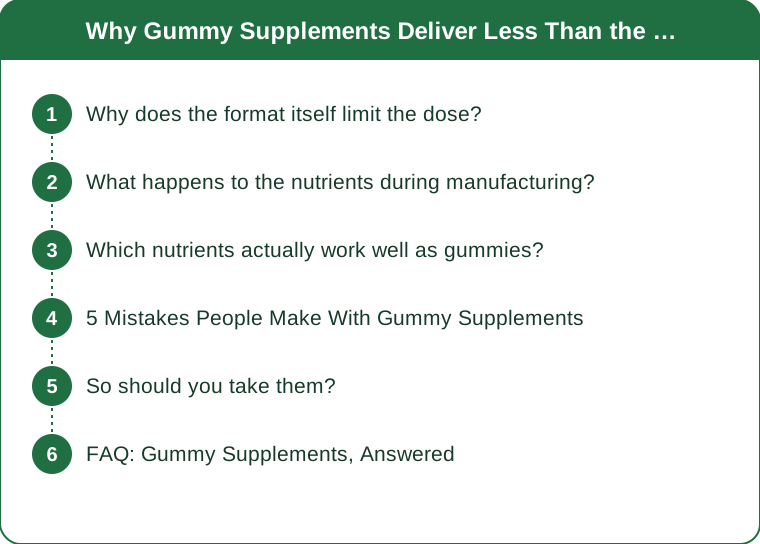
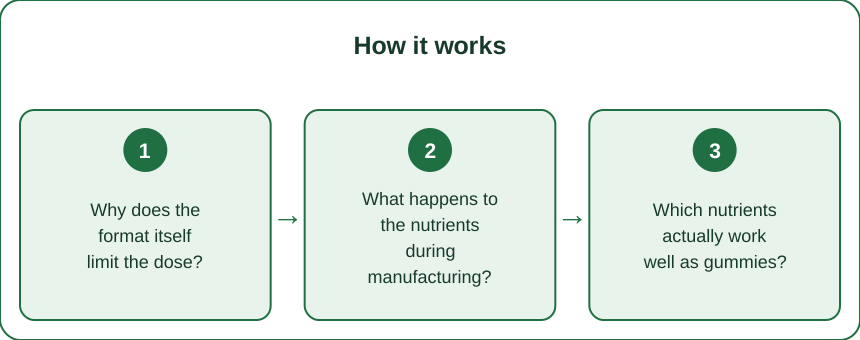
Why does the format itself limit the dose?
Because a gummy is mostly structure, and structure takes up room.
A gummy is a matrix of sugar or sugar alcohol, gelatin or pectin, water, acid, flavor, and color. All of that is doing a physical job — holding shape, tasting acceptable, staying chewable. The active ingredients get whatever volume is left.
Compare it to a capsule, where the shell is a thin container and the entire interior is available for the ingredient. A single capsule can hold a gram of powder. A gummy of similar size holds a fraction of that before it stops behaving like a gummy.
This is why you almost never see a full multivitamin dose in a single gummy — the serving is typically two or four, and even then several nutrients are present at lower amounts than the tablet equivalent. Magnesium is the clearest example: a meaningful dose is a few hundred milligrams, which is far more mineral than a gummy can carry without tasting like chalk.
The nutrients that survive this best are the ones needed in tiny amounts — vitamin D, vitamin B12, biotin, folate, vitamin K. Micrograms fit easily. The ones that suffer are the bulk minerals: magnesium, calcium, and iron, plus anything measured in grams like fish oil or creatine.
A practical filter: if the daily serving on the label is more than two gummies, the format is fighting the dose.
What happens to the nutrients during manufacturing?
They get heated, and heat is the enemy of several of them.
Gummy production involves cooking the base at temperatures well above what a tablet ever sees. The mix is heated to dissolve and set the gelling agent, then poured, then cooled. Vitamin C, folate, thiamine, and several B vitamins degrade with heat, which means the amount that goes in has to exceed the amount you want to come out.
Manufacturers handle this with overage — deliberately adding more than the label claims so the product still meets its claim at the end of shelf life. That is standard, legitimate practice across the supplement industry. It also means the actual content is above label early and drifting downward the whole time the bottle sits on a shelf.
Then there is ongoing degradation after manufacture. Gummies contain water. Water enables the chemical reactions that break nutrients down, which is precisely why tablets and capsules — which are dry — hold their content far longer. A gummy is a wet product with a shelf life to match.
Storage makes it worse or better. A bottle in a warm bathroom or a sunny kitchen degrades measurably faster than one in a cool cupboard. Gummies also melt and fuse, and a fused block has been through a heat cycle that its contents did not enjoy.
And independent testing keeps finding the gap. Third-party labs that test products against their labels have found gummy vitamins among the most frequent failures, in both directions — some well under, some substantially over.
Which nutrients actually work well as gummies?
The ones that are fat-soluble, needed in micrograms, and chemically stable.
Vitamin D3. Small dose, stable, fat-soluble, no taste problem. This is the single best case for a gummy and the one where you lose almost nothing versus a capsule.
Vitamin B12. Micrograms, stable, and genuinely useful for people who need it. Works fine.
Vitamin K2. Tiny dose, fat-soluble, pairs naturally with D3. Fine.
Biotin, folate, and most B vitamins are dosed small enough to fit, though several are heat-sensitive, so the overage question applies.
Where gummies fall down badly:
- Magnesium — the dose does not fit, full stop. A gummy magnesium is usually a fraction of a useful amount.
- Iron — tastes metallic, needs a real dose, and gummies are a genuine poisoning risk for children because they look like candy.
- Calcium — hundreds of milligrams. Not happening in a chew.
- Omega-3 — measured in grams of oil. A gummy claiming to replace fish oil is usually delivering a tenth of a study dose.
- Creatine — 3 to 5 grams a day. Physically impossible in this format at any reasonable serving size.
- Protein — no.
The sugar question, briefly: most gummies carry 2 to 5 grams of sugar or sugar alcohol per piece. At two gummies daily that is trivial for most people, and it is not trivial if you are taking four gummies of three different products, or if sugar alcohols upset your stomach — which for many people they do at exactly that dose.

5 Mistakes People Make With Gummy Supplements
1. Assuming the serving is one gummy. The label’s amounts are almost always per serving, and the serving is often two or four. Half the people taking gummy multivitamins are taking a quarter to a half of the intended dose because they eat one a day like a treat.
2. Storing them in the bathroom. Heat and humidity are the two things that degrade a water-containing product fastest. The bathroom cabinet is the worst location in the house, and it is where most people keep them because that is where the routine lives. Move them to a kitchen cupboard and set a phone reminder instead.
3. Stacking multiple gummy products. Three gummy products at two pieces each is six gummies, which is a meaningful amount of sugar and, more importantly, a real risk of doubling up on the same fat-soluble vitamins. Vitamin A and vitamin D both accumulate, and gummies make it easy to lose track because they do not feel like medicine.
4. Buying whatever is on the shelf. This is the category where third-party testing matters most, because the label-to-content gap is widest. Look for USP, NSF, or Informed Choice marks — they verify that what is inside matches what is claimed.
5. Leaving them where children can reach them. They look exactly like candy, they taste like candy, and iron-containing products in particular are genuinely dangerous to a child who eats a handful. This is the one item on this list that is not about efficacy.
So should you take them?
Yes, if the alternative is nothing. With one adjustment.
Adherence beats optimization every time. A gummy vitamin D you take 340 days a year does more for you than a capsule you take 40 days a year, and that is not a close comparison. If gummies are the reason the habit exists, keep the gummies.
The adjustment is to split your supplements by what fits the format. Use gummies for the micronutrients they carry well — D3, B12, K2 — and use capsules or powder for the bulk items where a gummy cannot deliver a real dose: magnesium, omega-3, creatine, iron, calcium.
Then handle the practical side:
- Read the serving size, and take that many.
- Store them cool and dry, away from the bathroom and out of sunlight.
- Buy third-party tested products — this category needs it more than any other.
- Check for overlap across everything you take, particularly vitamin A and D.
- Note the expiry and respect it, because a wet product genuinely does decline.
And test rather than guess where you can. For vitamin D and iron in particular, a blood test tells you whether the supplement is doing anything, which no label can. Ask your doctor what is worth measuring before you build a stack around assumptions.
Seasonal note: as daylight drops through autumn in most of the US, vitamin D intake becomes more relevant than it was in July — and that happens to be the one nutrient gummies genuinely deliver well.
FAQ: Gummy Supplements, Answered
Are gummy vitamins absorbed better because you chew them?
Chewing helps slightly for a few nutrients by starting the process earlier, and the effect is small compared to the amount actually present. Absorption is mostly determined by the nutrient’s chemical form and whether you take it with food — fat-soluble vitamins absorb better with a meal containing fat, in any format.
Do sugar-free gummies solve the sugar problem?
They replace sugar with sugar alcohols like maltitol, xylitol, or sorbitol, which are lower in calories and can cause bloating, gas, and loose stools at doses that four gummies easily reach. If a supplement gives you stomach trouble and you cannot work out why, the base is a likelier culprit than the vitamin.
How do I know if a product actually contains what it claims?Look for a third-party verification mark — USP Verified, NSF Certified for Sport, or Informed Choice — on the bottle, and check whether the brand publishes batch certificates of analysis. Those are the only practical signals available to a shopper. This is general information, not medical advice; talk to your doctor or a pharmacist before adding or stacking supplements, especially if you take prescription medication.
TL;DR:
- A gummy is mostly structure, so bulk nutrients like magnesium, calcium, iron, and omega-3 cannot fit at useful doses
- Manufacturing heat plus the water content means real degradation over shelf life, handled with label overages
- The format works genuinely well for vitamin D3, B12, and K2 — micrograms, stable, fat-soluble
- Take the full serving, store them cool and dry, buy third-party tested, and check for vitamin A and D overlap
- Keep gummies if they are the reason you take anything at all, and move the bulk items to capsules or powder
The gummy is not a scam, it is a compromise with a specific shape: excellent for the nutrients you need a speck of, poor for the ones you need a spoonful of. Sort your shelf along that line and the format stops costing you anything.
Keep Reading
This article is for general informational purposes only and is not medical advice. Always consult a qualified health professional for guidance specific to you.