Why Electrolyte Supplements Do Nothing If You Take Them After the Workout
Quick Answer: Electrolytes matter mostly for what they do during the session — keeping plasma sodium stable so you hold fluid, sustain blood volume, and avoid the drift in heart rate and performance that comes with dehydration. Taking them after you finish still helps you rehydrate, and it does nothing for the session that already happened. If you sweat heavily, the useful windows are before and during, and the post-workout sachet is the least valuable of the three.
Before and during is where the work happens.

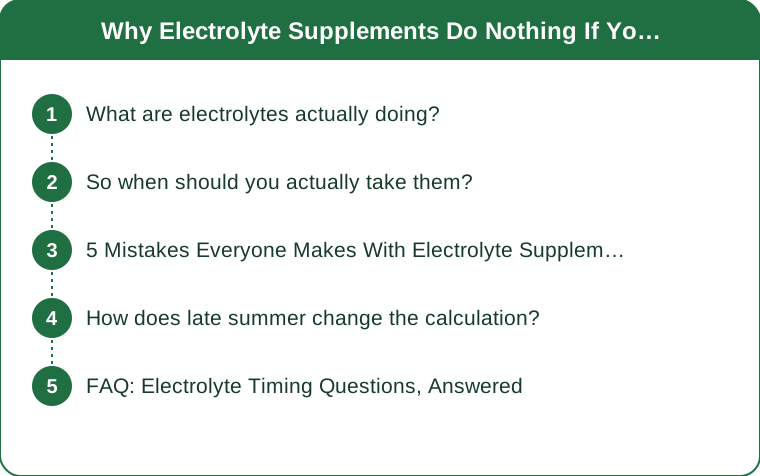
What are electrolytes actually doing?
Holding water where it belongs and keeping nerve and muscle signalling stable.
Sodium is the one that matters most in exercise. It is the primary electrolyte in the fluid outside your cells, and plasma sodium concentration is what determines whether the water you drink stays in circulation or gets excreted. Drink plain water while losing salt in sweat and you dilute plasma sodium, which triggers urination and leaves you with less usable fluid than you started with.
Blood volume is the performance link. As you dehydrate, plasma volume falls, so each heartbeat moves less blood, so heart rate rises to compensate. This is cardiovascular drift, and it is why the second half of a long session feels harder at the same pace.
Potassium, magnesium, and calcium matter too, and they are lost in much smaller quantities in sweat. Sodium concentration in sweat is roughly ten times potassium concentration, which is why sodium dominates any sensible replacement strategy.
Cramping is more complicated than the marketing suggests. Evidence for electrolyte depletion as the cause of exercise cramp is mixed, and neuromuscular fatigue appears to play a larger role. Heavy salt losers do appear to benefit, but treating a sachet as a guaranteed cramp cure overstates what the research supports.
The common thread in all of it is that these mechanisms operate while you are working. That is the timing clue.
So when should you actually take them?
Before and during, with the amount scaled to how much you sweat.
Before, roughly 30 to 60 minutes out, if the session will be long, hot, or hard. Around 400 to 600ml of fluid with sodium in it, so you start the session with plasma sodium supported rather than trying to catch up later.
During, for anything over about 60 minutes, or shorter than that in heat. Sipping 150 to 250ml every 15 to 20 minutes is the general shape, adjusted to conditions and to your own sweat rate.
After, to rehydrate what remains — which is a genuine use, and it is recovery rather than performance. Sodium in the recovery drink meaningfully improves fluid retention compared with plain water, so it is not useless. It simply cannot retroactively fix a session you finished dehydrated.
Sizing the dose:
Sweat sodium concentration varies enormously between people, roughly from 200 to over 1,500mg per litre. The visible marker is salt crusting on skin and dark rings on kit and caps — if that is you, you are at the high end and generic dosing will undershoot.
Sweat rate is easy to measure at home. Weigh yourself naked before and after an hour of exercise, without drinking. Each kilogram lost is roughly a litre of sweat, and that tells you far more than any product recommendation.
Do not over-drink plain water in long sessions. Drinking well beyond sweat losses without sodium is the mechanism behind exercise-associated hyponatraemia, which is rare and genuinely dangerous. More is not safer.

5 Mistakes Everyone Makes With Electrolyte Supplements
1. Taking them only after. The main mechanisms operate during the session. A post-workout sachet is a rehydration aid, not a performance one, and it is the timing most people default to because it is the most convenient.
2. Using them for every session. A 40 minute indoor strength session in air conditioning does not deplete you meaningfully. Routine use in short, cool, easy sessions is money for nothing, and it habituates you to a taste cue rather than a physiological need.
3. Choosing the low-sodium option. Many popular tablets contain modest sodium in a dose that looks reassuring on a label. If you sweat heavily for two hours, a tablet with 300mg of sodium replaces a small fraction of what you lost. Read the sodium figure and compare it to your losses.
4. Confusing sugar-free with better. Some sodium transport into the body is coupled with glucose, and for long sessions a small amount of carbohydrate helps both fluid absorption and fuelling. Sugar-free is right for short sessions and often wrong for long hot ones.
5. Assuming cramp means depletion. Cramp during a session is frequently neuromuscular and related to fatigue, novel intensity, or unfamiliar movement. If cramp only ever hits you at the end of the hardest efforts, electrolytes are unlikely to be the answer on their own.
How does late summer change the calculation?
It raises the stakes, and it is also the point in the year when people quietly stop paying attention.
Sweat rates in late August heat and humidity are at their annual peak. Humid air prevents evaporation, so you sweat more and get less cooling from it, which means larger fluid and sodium losses for the same work.
Heat acclimatisation cuts both ways. After a summer of training in heat, you sweat earlier and more, which is an adaptation that improves cooling. Acclimatised sweat is more dilute in sodium, so total losses are less extreme than volume alone suggests, and volume is still up.
Late summer sessions often move earlier in the day as evening light fades, which means starting sooner after waking, in a state where overnight fluid loss has not been replaced. The pre-workout dose matters more in a morning session than an evening one for exactly that reason.
Air conditioning masks losses indoors. A gym at 20°C after a 32°C commute produces less obvious sweating and still leaves you starting the session down on fluid.
Practical adjustments for the rest of the season:
Add the pre-session drink to any session over an hour, and to shorter ones outdoors in the middle of the day.
Weigh before and after once a week in the current conditions rather than relying on a figure you measured in May.
Watch urine colour first thing — pale straw is the target, and consistently dark first-morning urine through a hot week is worth acting on.
This is general information, not medical advice. Sodium intake interacts with blood pressure management and kidney function, so if you have high blood pressure, kidney disease, or take diuretics, talk to your doctor before adding sodium supplements to your routine.
FAQ: Electrolyte Timing Questions, Answered
Do I need electrolytes for a one hour gym session?
Usually not, if it is indoors and cool. Water is fine. They become relevant when the session runs long, the conditions are hot and humid, or you are a heavy salt loser.
Is the post-workout sachet a waste?
No, it aids rehydration, and sodium improves how much of what you drink you retain. It just cannot improve the session you already finished, which is what most people believe it is doing.
How do I know if I am a heavy salt loser?
White crusting on your skin, gritty residue on a cap or sunglasses, and salt rings on dark kit. If you see those regularly, standard dosing is likely to undershoot for you.
Can I just use salt and water?
For many people, yes — a pinch of salt in a bottle with some carbohydrate does most of what a commercial mix does. Commercial products offer convenience and consistent dosing rather than a unique mechanism.
TL;DR:
- Electrolytes work mainly during the session, by keeping plasma sodium stable so you hold fluid and blood volume.
- The valuable windows are 30 to 60 minutes before and every 15 to 20 minutes during; after is rehydration, not performance.
- Sodium is the electrolyte that matters most, and the right dose depends on your own sweat rate and salt concentration.
- Late summer heat and humidity push losses to their annual peak, which is exactly when routines drift.
Weigh yourself before and after one session this week. That number tells you more than any label does.
Keep Reading
This article is for general informational purposes only and is not medical advice. Always consult a qualified health professional for guidance specific to you.