Why Creatine Makes Some People Bloated and What Changes It
Quick Answer: Creatine bloating comes from two separate things people confuse: intracellular water drawn into muscle (which is the mechanism of benefit, not a side effect) and gastrointestinal bloating from undissolved powder or a large single dose. The GI version is the uncomfortable one, and it is almost entirely caused by loading doses, poorly dissolved monohydrate, and taking it on an empty stomach. Skip the loading phase, take 3 to 5 g daily, fully dissolved, with food - the bloating usually disappears within a week.
Here is the mechanism and each fix.

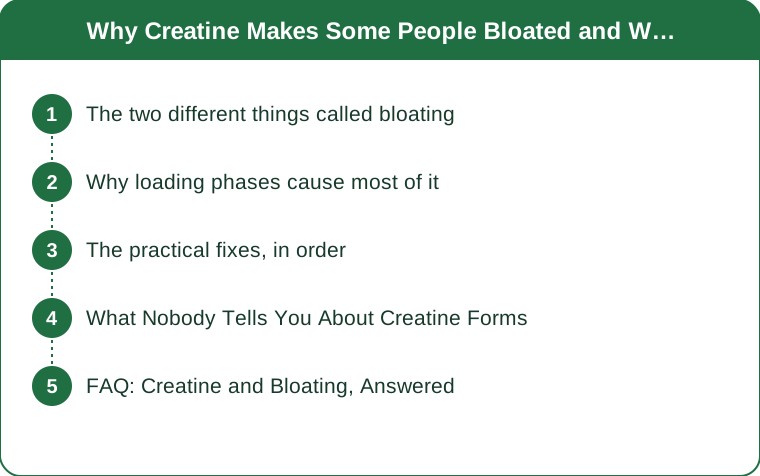
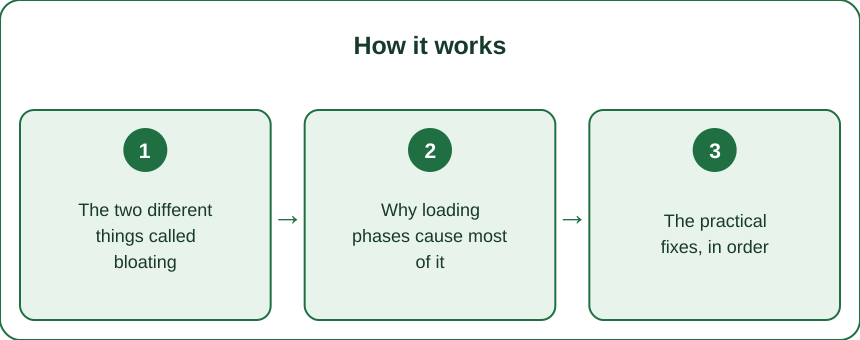
The two different things called bloating
Intracellular water retention is not bloating and is not a problem. Creatine is osmotically active, so storing more of it in muscle draws water into muscle cells - which is part of how it supports performance and possibly signals growth.
This shows up as a scale increase of roughly 1 to 2 kg in the first weeks. It is water inside muscle, not fat and not subcutaneous puffiness, and it does not look like bloating on the body.
Gastrointestinal bloating is the uncomfortable one. Abdominal distension, gurgling, and sometimes loose stools come from creatine sitting undissolved in the gut, drawing water into the intestinal lumen.
That is a dose and solubility problem, not a creatine problem. Creatine monohydrate has limited solubility in cold water - roughly 14 g per litre at room temperature - so a 5 g scoop in a small cold shake often does not fully dissolve.
The distinction matters because the fixes are opposite. Intracellular water needs no fix at all. GI bloating needs a smaller dose, warmer water, and food - and responds within days.
Most people describing creatine bloating mean the second one, and most of them are taking a loading dose when they say it.
Why loading phases cause most of it
A loading protocol is typically 20 g per day for five to seven days, usually split into four doses. That is four times the maintenance dose, and it is where nearly all GI complaints originate.
Loading is optional. It saturates muscle stores in about a week rather than about four weeks, but the end point is identical. Unless you have a competition in ten days, the faster route buys nothing.
5 g in a single sitting is already at the edge of comfortable for many people. 20 g in a day, even split, is well past it for a large minority.
The gut also does not adapt quickly. Loading concentrates the discomfort into exactly the week when someone is most likely to conclude that creatine does not agree with them and stop.
3 to 5 g daily reaches full saturation in three to four weeks with far fewer complaints. For most people that is simply the better protocol, and the research supports the end result being the same.
If you do want to load, split into four 5 g doses with meals rather than two large ones, and use warm water. That alone removes much of the problem.

The practical fixes, in order
Dissolve it properly. Use warm or room-temperature water rather than cold, stir or shake until the cloudiness clears, and drink it promptly. Undissolved grit in the bottom of the glass is the bloating, quite literally.
Take it with food. Creatine with a meal is better tolerated, and co-ingestion with carbohydrate and protein modestly improves uptake as a bonus. Empty-stomach dosing is the most common avoidable mistake.
Drop to 3 g if 5 g bothers you. The difference in saturation time is small, and a dose you take consistently beats a larger one you abandon.
Split the dose. 2.5 g twice daily with two meals is easier on the gut than 5 g at once and works identically.
Drink enough water across the day. Creatine increases total body water demand modestly, and mild dehydration makes both the GI symptoms and the general puffiness worse.
Give it a week before judging. Most GI symptoms settle within five to seven days of a dose or timing change, so change one variable and wait rather than stacking changes.
And check what else is in the tub. Many creatine products are blends with sweeteners, sugar alcohols, or caffeine. Sugar alcohols in particular cause exactly this kind of bloating and get blamed on the creatine.
What Nobody Tells You About Creatine Forms
Monohydrate is the most studied form and the cheapest, and no alternative form has convincingly beaten it on effectiveness. Marketing for other forms usually leans on the bloating claim rather than on performance data.
Micronised monohydrate is genuinely worth the small extra cost for anyone with GI symptoms. It is the same molecule with a much smaller particle size, so it dissolves far more readily - and dissolution is the actual problem.
Creatine HCl dissolves more easily and is usually dosed lower. The evidence that it outperforms monohydrate is thin, but for someone who cannot tolerate monohydrate at all, better tolerated at a lower dose is a real advantage.
Buffered forms and liquid creatine are generally not worth it. Liquid creatine in particular degrades to creatinine over time in solution, which is why powders exist in the first place.
Look for a third-party testing mark on whichever form you choose. Creatine is a commodity ingredient, and quality varies more than price suggests.
Gummies are a genuine problem for creatine specifically. Dose per gummy is low, stability in a gummy matrix is questionable, and reaching 5 g often means an unreasonable number of them.
And the timing debate is mostly noise. Total daily intake and consistency drive saturation. Take it whenever you will actually take it every day - the tolerability question is far more important than the clock.
FAQ: Creatine and Bloating, Answered
Does creatine actually make you look bloated?
The water creatine holds is intracellular - inside muscle - which does not read as puffiness. Visible abdominal bloating is usually gastrointestinal, caused by undissolved powder or too large a single dose.
How much weight will I gain on creatine?
Typically 1 to 2 kg in the first few weeks, and it is water stored inside muscle rather than fat. It stabilises and is not a sign anything is going wrong.
Do I need a loading phase?
No. Loading saturates stores in about a week instead of three to four, with an identical end point. It is also where nearly all the bloating complaints come from.
What is the best dose to avoid bloating?
3 to 5 g daily, taken with food, fully dissolved in warm or room-temperature water. Splitting into 2.5 g twice daily helps further if symptoms persist.
Why does my creatine not dissolve?
Monohydrate has limited solubility in cold water - roughly 14 g per litre at room temperature. Cold water and a small volume leave grit at the bottom, and that undissolved powder is what causes GI symptoms.
Is micronised creatine worth paying more for?
If you get bloating, yes. It is the same molecule with a smaller particle size, so it dissolves far more readily - and dissolution is the actual cause of the discomfort.
How long until the bloating goes away?
Usually five to seven days after changing the dose, the timing, or the dissolution. Change one variable at a time and wait a week rather than changing everything at once. Persistent GI symptoms are worth discussing with a healthcare professional - this is general information, not medical advice.
TL;DR:
- Two different things get called bloating. Intracellular water in muscle is the mechanism of benefit; GI bloating is the uncomfortable one.
- Loading phases cause most complaints. 20 g a day is four times maintenance and buys only a few weeks of time.
- Take 3 to 5 g daily with food, fully dissolved in warm or room-temperature water.
- Undissolved grit is the bloating. Monohydrate dissolves poorly in cold water - about 14 g per litre.
- Micronised monohydrate is the cheapest real fix if symptoms persist. Same molecule, smaller particles.
- Check the tub for sugar alcohols - they cause exactly this bloating and get blamed on the creatine.
- Expect 1 to 2 kg of scale weight, and that it is water inside muscle rather than fat.
Change one variable and wait a week. Persistent GI symptoms deserve a proper conversation with a healthcare professional - this is general information, not medical advice.
Keep Reading
This article is for general informational purposes only and is not medical advice. Always consult a qualified health professional for guidance specific to you.