Why Your Supplements Might Be Losing Potency in Your Bathroom Cabinet
Quick Answer: Bathroom cabinets are one of the worst places to store most supplements because heat and humidity from showers accelerate the breakdown of active compounds, especially in probiotics, fish oil, and anything with a gelatin capsule — a cool, dry drawer or pantry shelf away from direct light preserves potency significantly longer.
Storing supplements next to the sink where you take them is convenient, but that convenience comes with a real, measurable cost to how effective those supplements stay over time.

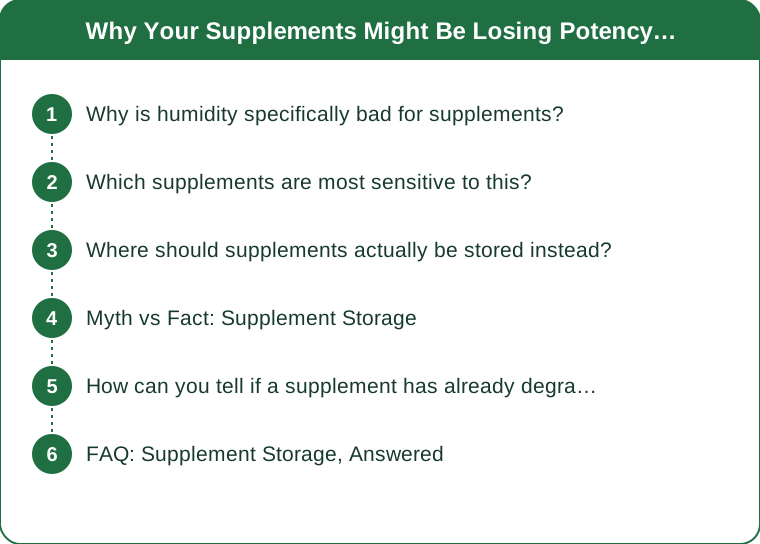
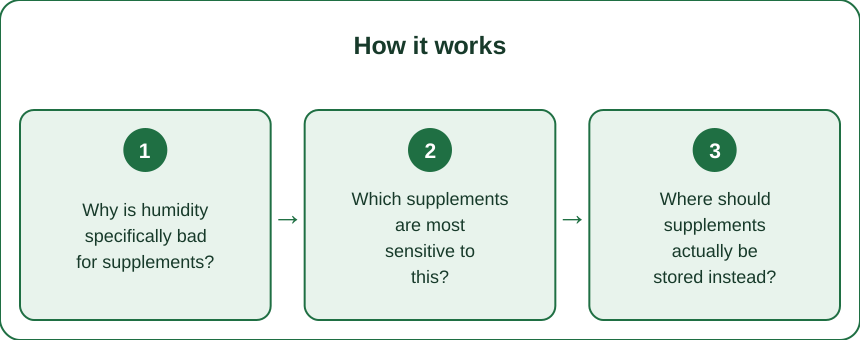
Why is humidity specifically bad for supplements?
Moisture in the air accelerates chemical breakdown of many active compounds and can cause gelatin capsules to soften, stick together, or degrade faster than their labeled shelf life. Bathrooms cycle through significant humidity swings every time a shower or bath runs hot, making them one of the most humidity-variable rooms in a typical home.
Powders are especially vulnerable — protein powder, greens powders, and collagen can clump or develop moisture-related degradation well before their printed expiration date if stored somewhere humid.
Which supplements are most sensitive to this?
Probiotics are the most sensitive of all — many strains are live cultures that die off measurably faster in heat and humidity, which is why some brands specify refrigeration even before opening. Fish oil and other omega-3 products oxidize faster in warm, humid, or light-exposed conditions, and oxidized fish oil not only loses potency but can develop a notably stronger fishy smell, which is itself a warning sign.
Vitamin C and other water-soluble vitamins also degrade faster with heat and light exposure than more stable minerals like calcium or magnesium, which are comparatively resilient to storage conditions.
Where should supplements actually be stored instead?
A cool, dry drawer, pantry shelf, or bedroom dresser drawer — somewhere with stable temperature, low humidity, and no direct sunlight — is ideal for most supplements. A kitchen cabinet away from the stove and any water source works well for most households, since it’s typically dry and out of direct light while still being convenient enough to actually remember to use daily.

Myth vs Fact: Supplement Storage
Myth: “If it’s in a sealed bottle, storage location doesn’t matter.” Fact: bottles are opened and closed daily, letting in ambient humidity and temperature each time — a sealed bottle in a bad location still degrades over its months of actual use.
Myth: “Refrigeration is always better for supplements.” Fact: only specific products (some probiotics, certain fish oils after opening) benefit from refrigeration; condensation from moving a bottle in and out of a cold fridge can actually introduce more humidity risk for products that don’t need it.
Myth: “Expiration dates account for real-world storage conditions.” Fact: printed shelf life is typically based on ideal, controlled storage conditions — actual potency loss can happen well before that date if storage is poor.
How can you tell if a supplement has already degraded?
Visible clumping in powders, capsules that have softened, stuck together, or changed color, and any notably stronger or off smell (especially in fish oil) are the clearest signs. When in doubt with a product you suspect was poorly stored, it’s reasonable to replace it rather than continue taking something with uncertain potency.
FAQ: Supplement Storage, Answered
Do I need airtight containers in addition to the original bottle?
Not usually necessary if the original bottle reseals well — the bigger factor is room location and humidity, not container type, assuming the original packaging is intact and closes properly.
Does storage really matter enough to change effectiveness meaningfully?
For heat- and humidity-sensitive products like probiotics and fish oil, yes, measurably — for more stable products like calcium or vitamin D, storage location matters less, though cool and dry is still the safer default for everything.
Should I move my supplements even if I haven’t noticed any problems yet?
It’s a low-effort change worth making proactively — potency loss from poor storage isn’t always obvious until a product is significantly degraded, so there’s little downside to switching to a better spot now.
TL;DR:
- Bathroom humidity and heat accelerate potency loss in many supplements, especially probiotics and fish oil
- A cool, dry drawer or pantry shelf away from light is a better default storage spot
- Clumping, softened capsules, and stronger smells (especially in fish oil) signal degradation
- Not every supplement needs refrigeration — check the label rather than assuming colder is always better
A five-minute cabinet swap is a small change that protects the actual potency of what you’re already paying for.
Keep Reading
This article is for general informational purposes only and is not medical advice. Always consult a qualified health professional for guidance specific to you.