Powder or Capsule: Why the Same Supplement Behaves Differently
Quick Answer: Powders dissolve immediately and begin absorbing as soon as they reach the small intestine, while capsules must first break down, which adds fifteen to forty-five minutes and depends heavily on stomach contents and hydration. For anything where timing matters — creatine before training, electrolytes mid-session, collagen with a meal — powder has a real advantage. For anything sensitive to stomach acid, unpleasant tasting, or dosed in small amounts, capsules are usually the better delivery. Dose accuracy also differs, and not in the direction most people assume.
The format is a genuine variable, not just a preference.
We have covered why taking supplements at the wrong time wastes most of them, why splitting a dose beats doubling it, and why a supplement that works on paper can still do nothing. Format is the piece that sits underneath all three.

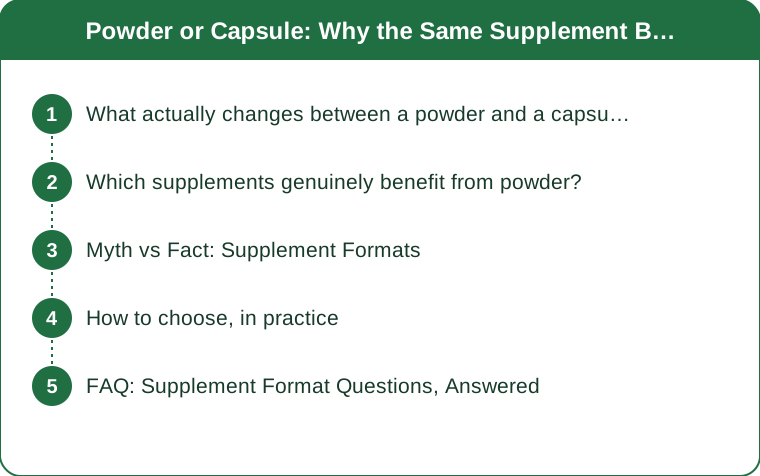
What actually changes between a powder and a capsule?
Four things, and the first one drives the rest.
Disintegration time. A powder is already disintegrated. A capsule shell has to dissolve first, which takes anywhere from a few minutes to over half an hour depending on the shell material and what else is in your stomach.
Surface area on contact. Powder disperses through the stomach contents immediately, presenting a very large surface area to digestive fluids. A capsule releases its contents as a concentrated plug in one location.
Dose flexibility. Powder lets you take a partial dose, which matters enormously for anything where splitting improves tolerance or absorption. A capsule is all or nothing.
Protection from stomach acid. A capsule, particularly an enteric-coated one, can carry acid-sensitive compounds past the stomach entirely. A powder cannot.
And the excipients differ. Capsules need flow agents and fillers to run through machinery; powders need solubility aids and often flavouring. Neither list is inherently worse, but they are different.
Which supplements genuinely benefit from powder?
The ones where dose is large, timing is tight, or the dose needs adjusting.
Creatine. Five grams is far too much for capsules without taking six or seven of them, and dissolving it in water gets it into the system quickly and cheaply.
Electrolytes. These need to arrive with fluid to do anything useful, which makes a powder in a bottle the obvious format rather than a preference.
Protein and collagen. Gram-scale doses are simply impractical in capsule form, and both are stable in water.
Anything you are titrating. If you are working up gradually to find the dose you tolerate, powder is the only format that lets you move in small increments.
Anything for pre-workout timing. A powder taken thirty minutes before training is reliably absorbed by the time you start. A capsule taken at the same moment may still be dissolving.
And anything you take with a meal you are already making. Stirring a powder into yoghurt or a smoothie removes the compliance problem entirely, which matters more than any absorption difference.

Myth vs Fact: Supplement Formats
Myth: Powders always absorb better than capsules. Fact: They absorb faster, which is not the same thing. Total absorption over several hours is often similar. Speed matters for creatine and electrolytes; for a daily vitamin D it is irrelevant.
Myth: Capsules are just a more expensive version of the same thing. Fact: For acid-sensitive compounds and probiotics, the shell is doing real work. An enteric coating exists to survive the stomach, and no powder can replicate that.
Myth: A scoop is an accurate dose. Fact: Scoop density varies enormously with settling, humidity and how you fill it. Underfilled and heaped scoops can differ by thirty percent or more. Capsules are far more consistent per unit.
Myth: Opening a capsule and mixing the powder is the same as buying the powder. Fact: Sometimes, and sometimes it defeats the entire point of the shell. Never open enteric-coated or delayed-release capsules; the coating is the product.
Myth: Powder is always cheaper. Fact: Per gram of active ingredient, usually yes, particularly at large doses. At small doses the difference is often trivial and the capsule wins on convenience and accuracy.
Myth: If it dissolves clear, it absorbed well. Fact: Solubility in a glass tells you nothing about absorption across the gut wall. Plenty of poorly absorbed compounds dissolve beautifully.
How to choose, in practice
Six questions that settle it faster than any comparison chart.
Is the dose above about a gram? If yes, powder. Capsule counts become impractical fast.
Does timing matter within the hour? If yes, powder. The disintegration delay of a capsule is unpredictable enough to matter.
Is the compound acid-sensitive or a probiotic? If yes, capsule, and specifically a delayed-release one.
Does it taste bad enough that you will skip it? Capsule, without hesitation. The best-absorbed supplement is the one you actually take.
Are you adjusting the dose? Powder, and weigh it on a small scale rather than trusting the scoop.
Do you travel with it? Capsules, in most cases. Powder plus humidity plus a bag is how you get a solid brick and a wasted tub.
And a practical note on storage: powders draw moisture and clump, which changes scoop density and therefore your dose. Keep the desiccant packet in the tub, close it properly, and do not store it above the kettle.
FAQ: Supplement Format Questions, Answered
Is powder better absorbed than capsules?
Faster, not necessarily better. Powder begins absorbing immediately, while a capsule adds fifteen to forty-five minutes for the shell to break down. Over a full day, total absorption is often comparable. Speed matters most for creatine, electrolytes and pre-workout timing.
Can I open a capsule and mix the contents into a drink?
For a standard capsule, usually yes. For enteric-coated or delayed-release capsules, no — the coating exists specifically to protect the contents from stomach acid, and opening it destroys the product you paid for.
Is a scoop an accurate dose?
Less accurate than most people assume. Powder settles and absorbs moisture, so the same scoop can vary by a third depending on humidity and how you fill it. If the dose matters, use a small kitchen scale.
TL;DR:
- Powder dissolves instantly; a capsule adds fifteen to forty-five unpredictable minutes before absorption begins.
- Choose powder for large doses, tight timing and adjustable dosing. Choose capsules for acid-sensitive compounds, bad tastes and travel.
- Scoops are far less accurate than capsules. Weigh anything where the dose genuinely matters.
- Never open an enteric-coated capsule. The coating is the product.
Format is not a preference question. It changes when the supplement arrives and how much of it survives the trip.
Keep Reading
This article is for general informational purposes only and is not medical advice. Always consult a qualified health professional for guidance specific to you.