Which Supplements Actually Need Morning vs Night Timing (And Which Don't Matter)
Quick Answer: A handful of supplements have real timing requirements — magnesium and melatonin work better at night, B vitamins and iron are best taken in the morning to avoid sleep disruption or interference, and fat-soluble vitamins (A, D, E, K) need to be taken with a meal containing fat regardless of time of day. Most others have flexible timing that matters far less than daily consistency.
Supplement labels and wellness content make it sound like timing is make-or-break for every single pill in your cabinet. For a few, it genuinely is. For most, consistency matters more than the specific hour — but knowing which is which saves you from either wasted effort or a real missed benefit.

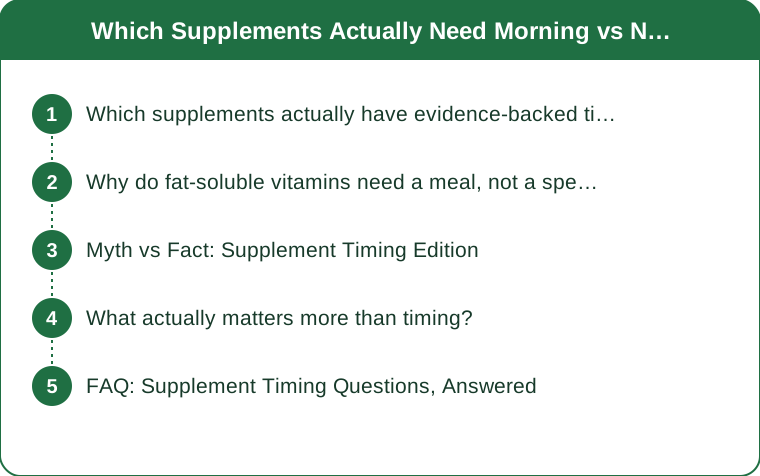
Which supplements actually have evidence-backed timing?
Magnesium glycinate: evening, since it supports relaxation and sleep onset for many people — taking it in the morning doesn’t reduce effectiveness, just misses a secondary benefit.
Melatonin: strictly evening, 30-60 minutes before bed — taking it at other times can actually shift your circadian rhythm in unintended directions.
B-complex vitamins: morning, since B12 and B6 can have a mildly energizing effect that disrupts sleep onset for some people if taken late.
Iron: morning, on an empty stomach when possible, since food (especially dairy and coffee) meaningfully reduces its absorption.
Why do fat-soluble vitamins need a meal, not a specific time?
Vitamins A, D, E, and K require dietary fat present in the stomach to be absorbed properly — taken on a completely empty stomach with no fat, absorption can drop significantly regardless of what time of day it is.
This is a meal-pairing rule, not a clock-time rule: taking vitamin D with breakfast that includes eggs or avocado works exactly as well as taking it with a dinner that includes fat. The meal matters; the specific hour doesn’t.

Myth vs Fact: Supplement Timing Edition
Myth: Probiotics must be taken first thing in the morning on an empty stomach. Fact: Evidence is mixed; some strains survive stomach acid better with food present. Consistency in timing matters more than a specific ‘correct’ hour.
Myth: Taking all your supplements at once reduces absorption of each. Fact: For most common supplements, taking them together causes minimal interaction — the main documented exceptions are calcium interfering with iron and zinc absorption if taken simultaneously.
Myth: Vitamin C must be taken with iron to work. Fact: Vitamin C does enhance iron absorption meaningfully, but iron works without it too — pairing them is a bonus, not a requirement.
What actually matters more than timing?
Daily consistency — taking a supplement at a roughly similar time (within a few hours) every day produces more reliable blood levels over weeks than perfect timing done inconsistently. Missed or randomly-timed doses undermine most supplements’ effectiveness far more than an hour or two of timing variance ever would.
If perfect timing is the barrier to taking a supplement consistently at all, simplify: pick one time daily that you’ll actually stick to, and treat that as correct enough.
FAQ: Supplement Timing Questions, Answered
Can I take all my supplements at the same time of day?
For most people and most supplements, yes — the exceptions (calcium blocking iron/zinc, melatonin needing evening specifically) are the ones to space out; everything else can reasonably go together.
Does taking supplements with or without food matter beyond fat-solubility?
Some supplements (like certain probiotics or NSAIDs-adjacent ones) are gentler on the stomach with food, even without a strict absorption requirement — check individual product guidance for stomach comfort, separate from absorption science.
Is it worth setting phone reminders for supplement timing?
For consistency, yes — a daily reminder at your chosen time solves the bigger problem (missed doses) far more effectively than optimizing the specific hour.
TL;DR:
- Real timing requirements exist for: melatonin and magnesium (evening), B-complex and iron (morning)
- Fat-soluble vitamins (A, D, E, K) need a meal with fat present — the meal matters, not the clock hour
- Most other supplement timing ‘rules’ are flexible; the main real interaction to avoid is calcium blocking iron/zinc
- Daily consistency beats perfect timing — pick one sustainable time and stick to it
Focus your timing effort on the handful of supplements where it actually changes outcomes, and let consistency do the work for everything else.
Keep Reading
This article is for general informational purposes only and is not medical advice. Always consult a qualified health professional for guidance specific to you.