Does Taking Supplements on an Empty Stomach Actually Improve Absorption?
Quick Answer: It depends entirely on the supplement — fat-soluble vitamins (A, D, E, K) absorb better with food containing fat, while some minerals like iron absorb better on an empty stomach. There’s no single universal rule.
Empty-stomach advice gets repeated as a blanket rule online, but the actual science splits supplements into very different categories.

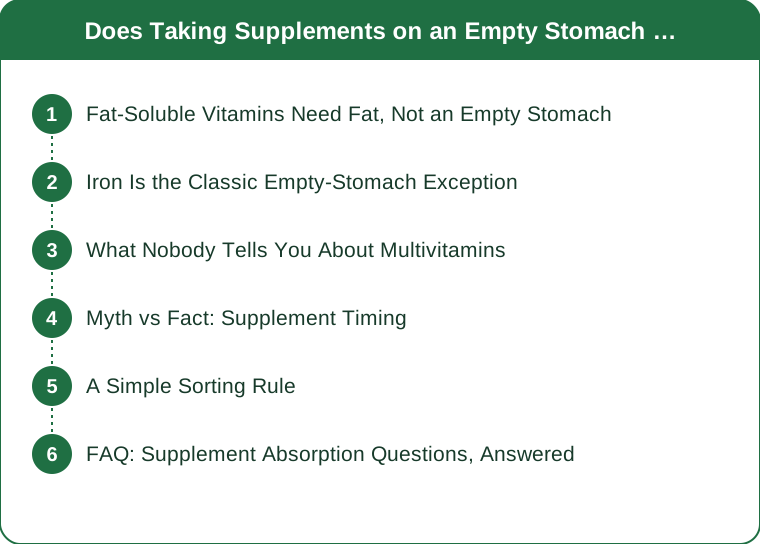
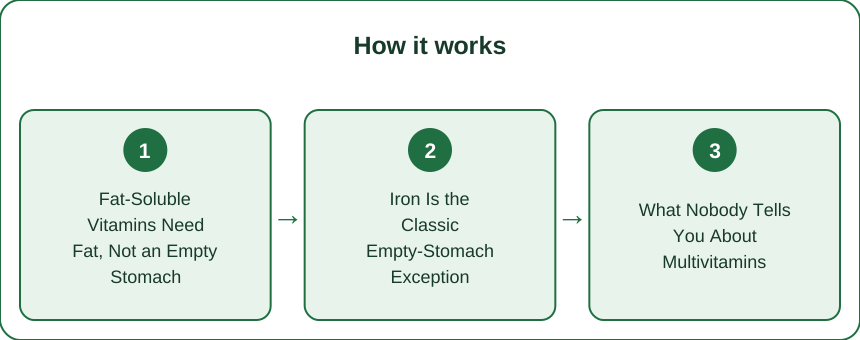
Fat-Soluble Vitamins Need Fat, Not an Empty Stomach
Vitamins A, D, E, and K require dietary fat for absorption into the bloodstream. Taking vitamin D on an empty stomach can reduce its absorption by up to 50% compared to taking it with a meal containing some fat, like eggs or avocado.
Iron Is the Classic Empty-Stomach Exception
Iron absorbs significantly better without food, particularly without calcium or coffee/tea nearby, which block absorption. However, iron on an empty stomach also causes stomach upset for many people — a small amount of food (not dairy, not caffeine) is a reasonable compromise if nausea is an issue.
What Nobody Tells You About Multivitamins
A standard multivitamin contains both fat-soluble and water-soluble ingredients, so it’s genuinely a mixed bag — taking it with a meal containing some fat generally improves overall absorption without meaningfully hurting the water-soluble components.

Myth vs Fact: Supplement Timing
Myth: Empty stomach always means better absorption. Fact: it’s the opposite for fat-soluble vitamins and many minerals. Myth: Timing doesn’t matter if you take it consistently. Fact: consistent timing with the wrong food pairing can mean consistently poor absorption, not just inconsistent absorption.
A Simple Sorting Rule
If a supplement label mentions vitamins A, D, E, K, omega-3s, or CoQ10, take it with a meal containing some fat. If it’s iron specifically and you tolerate it, take it separately from meals and away from coffee, tea, or calcium supplements by at least 1-2 hours.
FAQ: Supplement Absorption Questions, Answered
Does magnesium need to be taken with food?
Magnesium is generally well tolerated either way, but taking it with food reduces the mild stomach upset some people experience.
Can I take all my supplements at the same time?
Most can be taken together with a meal, except iron, which should be separated from calcium and dairy by a couple hours to avoid absorption competition.
Does the time of day matter as much as food pairing?
Food pairing generally matters more than time of day for absorption, though some people find fat-soluble vitamins in the morning and magnesium in the evening works well for their routine.
TL;DR:
- Fat-soluble vitamins (A, D, E, K) absorb better with food containing fat
- Iron absorbs better on an empty stomach, away from calcium and caffeine
- Multivitamins generally do better paired with a meal overall
- Sort by supplement type rather than following one blanket empty-stomach rule
The empty-stomach rule isn’t wrong — it’s just incomplete. Match the timing to the specific nutrient, not a one-size-fits-all habit.
Keep Reading
This article is for general informational purposes only and is not medical advice. Always consult a qualified health professional for guidance specific to you.