Do You Actually Need to Cycle Off Supplements?
Quick Answer: Most supplements do not require cycling. Creatine, in particular, does not need to be cycled — the loading-and-break protocol is a holdover from early marketing, not a physiological requirement. Cycling genuinely matters for a small group: stimulants like caffeine, where tolerance builds fast, and certain herbal adaptogens where long-term data is thin. Fat-soluble vitamins need monitoring rather than cycling, because the risk is accumulation, not tolerance.
Someone told you your body gets used to it. Someone else said your receptors downregulate. A third person said your liver needs a rest.
Three different mechanisms, applied indiscriminately to a shelf of products that work in completely different ways. The right question is not whether to cycle, but whether the specific thing you are taking has a tolerance mechanism, an accumulation risk, or neither. The third section covers the one category where people cycle the wrong way around.

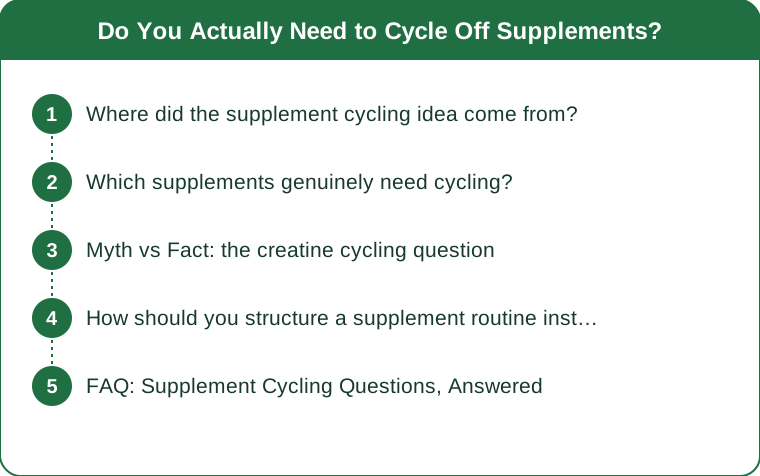
Where did the supplement cycling idea come from?
Three legitimate ideas got flattened into one bad rule.
Pharmaceutical tolerance. Some drugs produce receptor downregulation — the body responds to a steady signal by reducing sensitivity to it. This is real, well documented, and specific to particular mechanisms of action. It got generalized to every pill.
Anabolic steroid cycling. Exogenous hormones suppress your own production, so cycling off allows recovery. This is a hormone-specific issue that has essentially nothing to do with a multivitamin, but the vocabulary of cycling migrated across from bodybuilding culture into general supplementation.
Marketing. A product with a prescribed loading phase, maintenance phase, and washout period sounds sophisticated and sells better than take one daily. Creatine is the clearest case — the loading protocol and periodic breaks became conventional wisdom without the physiology to support them.
The useful reframe: ask what would actually change if you kept taking it. Would your receptors adapt? Would it accumulate in tissue? If neither, there is nothing for a break to accomplish.
Which supplements genuinely need cycling?
A short and specific list.
Caffeine and stimulants — yes. Tolerance to the alertness effect develops within days to weeks, and it is a genuine receptor-level adaptation. If your morning coffee has stopped doing anything, a deliberate reduction period of one to two weeks restores sensitivity. This is the clearest case for cycling in the whole category.
Some herbal adaptogens — probably. Ashwagandha, rhodiola, and similar botanicals are typically studied in trials lasting weeks to a few months, so continuous multi-year use is genuinely outside the evidence base. Many practitioners suggest periodic breaks less because tolerance is proven and more because long-term safety data does not exist. That is a reasonable precaution, not a proven requirement.
Anything with a hormonal mechanism — discuss it with a clinician. This is not a self-managed cycling question.
Fat-soluble vitamins (A, D, E, K) — monitoring, not cycling. These accumulate in tissue, so the concern is dose, not tolerance. The correct management is periodic blood testing and adjusting the dose, not taking random months off.
Notably absent from this list: creatine, protein powder, most minerals, B vitamins, omega-3s. These have no tolerance mechanism to reset.

Myth vs Fact: the creatine cycling question
Myth: You must load creatine for a week, then cycle off every few months so your body does not stop making its own.
Fact: Neither half of that is required.
On loading: a loading phase saturates muscle creatine stores faster — days rather than weeks. Taking a standard daily dose without loading reaches the same saturation point, just more gradually. Loading is a speed choice, not a necessity, and it is the phase most associated with digestive complaints.
On cycling: your body does downregulate its own synthesis somewhat while supplementing, and it returns to baseline when you stop. This is a normal, reversible regulatory response, not damage. Long-term studies of continuous daily creatine use in healthy adults have not established a need for washout periods.
The practical effect of cycling creatine is that you spend part of each cycle below saturation, getting less benefit than if you had simply kept taking it. People cycle it the wrong way round — they take breaks from the thing that needs consistency, while drinking coffee every single day without ever resetting the one substance in their routine that genuinely builds tolerance.
Where a break does make sense: if you want to know whether something is doing anything. Stopping for three or four weeks and observing is a legitimate personal experiment — that is testing, not cycling.
How should you structure a supplement routine instead?
Replace cycling with three habits that do more:
Audit quarterly. Every three months, go through what you take and ask what each item is for and how you would know if it were working. Anything you cannot answer for is a candidate to drop. Routines accrete — people end up with nine bottles because each one made sense the month they bought it.
Test what is testable. Vitamin D, ferritin, and B12 all have straightforward blood tests. Supplementing these blind is guessing in both directions — you can be under-dosing something you need and over-dosing something you already have plenty of.
Cycle the one thing that actually builds tolerance. If caffeine has stopped working, taper it for a week or two rather than climbing the dose.
Watch total intake, not per-product dose. The realistic overdose risk comes from stacking — a multivitamin, a fortified protein powder, and a standalone vitamin can add up past what any single label suggests. This is the accumulation problem, and it is managed by adding up your labels, not by taking months off.
Seasonal note: as daylight shortens into fall, vitamin D is one of the few supplements where a seasonal adjustment genuinely makes sense for many people at northern latitudes — but the right way to make it is a blood test, not a calendar.
FAQ: Supplement Cycling Questions, Answered
Will my body stop absorbing a supplement if I take it every day?
For vitamins and minerals, no — absorption is regulated by your current status, not by habituation. If anything, absorption goes up when you are depleted and down when you are replete, which is the system working correctly.
Is it bad to take a multivitamin every day for years?
For most healthy adults at standard doses, no. The thing worth checking periodically is whether it overlaps with your other supplements on fat-soluble vitamins or iron, since those are the ones that accumulate.
How long should a caffeine reset be?
One to two weeks of substantially reduced intake is usually enough to restore noticeable sensitivity. Taper rather than stopping abruptly — the withdrawal headache is real and lasts a few days.
This is general information, not medical advice. Talk to a clinician or pharmacist before starting, stopping, or combining supplements, especially if you take prescription medication.
TL;DR:
- Most supplements have no tolerance mechanism, so there is nothing for a break to reset.
- Cycling genuinely matters for caffeine and stimulants, and is a reasonable precaution for herbal adaptogens.
- Creatine does not need loading or cycling — breaks just cost you saturation.
- Fat-soluble vitamins need blood testing and dose adjustment, not calendar breaks.
- Replace cycling with a quarterly audit, actual testing, and adding up your total intake across products.
The instinct behind cycling is a good one — it is really a suspicion that you might be taking things you do not need, and that suspicion is often correct. But a scheduled month off does not answer it. Pulling one product for a few weeks and paying attention does, and so does a blood test for the handful of things worth measuring. Keep the consistency where consistency is the whole point, put the break where tolerance actually builds, and let the rest of the shelf earn its place on evidence rather than ritual.
Keep Reading
This article is for general informational purposes only and is not medical advice. Always consult a qualified health professional for guidance specific to you.