The Creatine Loading Phase Myth: Why Skipping It Doesn't Actually Slow Your Results
Quick Answer: A creatine loading phase (roughly 20g/day for 5-7 days) saturates your muscles faster, but skipping it and taking a steady 3-5g daily gets you to the same saturation point in about 3-4 weeks instead of 1 — the end result is identical, loading just changes the timeline, not the outcome.
Every tub of creatine seems to come with instructions for a loading week that feels intense — four scoops a day, spread out, for seven days straight. If that sounds like a lot of powder for very little payoff, that’s because for most people, it genuinely isn’t necessary.

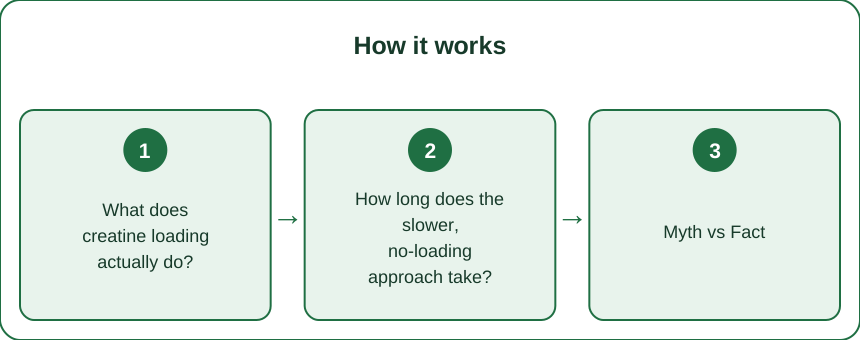
What does creatine loading actually do?
Loading floods your system with roughly 20 grams a day for 5-7 days, saturating your muscle creatine stores faster than a standard daily dose would. It’s a speed strategy, not a different destination — both approaches lead your muscles to the same saturation ceiling eventually.
How long does the slower, no-loading approach take?
Taking a steady 3-5 grams daily without a loading phase reaches the same full muscle saturation in about 3-4 weeks instead of roughly a week. If you’re not chasing a specific short deadline (a meet, a photo shoot), there’s no performance disadvantage to the slower route.

Myth vs Fact: Creatine Loading
Myth: Skipping the loading phase means creatine ‘doesn’t work as well’ for you. Fact: it works identically once saturated — you just get there a few weeks later instead of a week in.
Myth: Loading phase side effects (bloating, stomach discomfort) mean you’re allergic or intolerant. Fact: they’re usually just a dose-response effect from a large volume of powder at once — spreading loading doses across the day, or skipping loading entirely, usually resolves it.
Myth: You need to keep taking a higher dose forever to stay saturated. Fact: once saturated (via either method), a maintenance dose of 3-5g daily is enough — more doesn’t meaningfully add benefit.
Who might actually benefit from loading?
Athletes with a specific event 1-2 weeks out who want the performance benefit sooner. For anyone with a long-term, ongoing training goal rather than a near-term event, the loading phase is optional convenience, not a requirement for results.
FAQ: Creatine Loading Phase, Answered
Does loading phase creatine cause more water retention?
Initially, yes — creatine draws water into muscle cells, and loading causes this faster and more noticeably. It levels out at the same point either way once you’re at maintenance dose.
Can I switch from loading to a lower daily dose later?
Yes — many people load for a week, then drop to a 3-5g maintenance dose indefinitely without any loss of effect.
Does skipping loading save money on supplement cost?
Yes, meaningfully — spreading the same total monthly creatine over 4 weeks instead of loading uses less product overall in that first month, which adds up if you’re buying regularly.
TL;DR:
- Loading (20g/day for a week) and a steady 3-5g daily dose reach the same saturation, just at different speeds
- No-loading approach takes about 3-4 weeks instead of about 1 week
- Loading phase stomach discomfort is usually dose-related, not an intolerance to creatine itself
- Loading is a convenience for near-term events, not a requirement for long-term results
If you’re not on a deadline, skip the loading powder pile and just start with a daily maintenance dose.
Keep Reading
This article is for general informational purposes only and is not medical advice. Always consult a qualified health professional for guidance specific to you.